

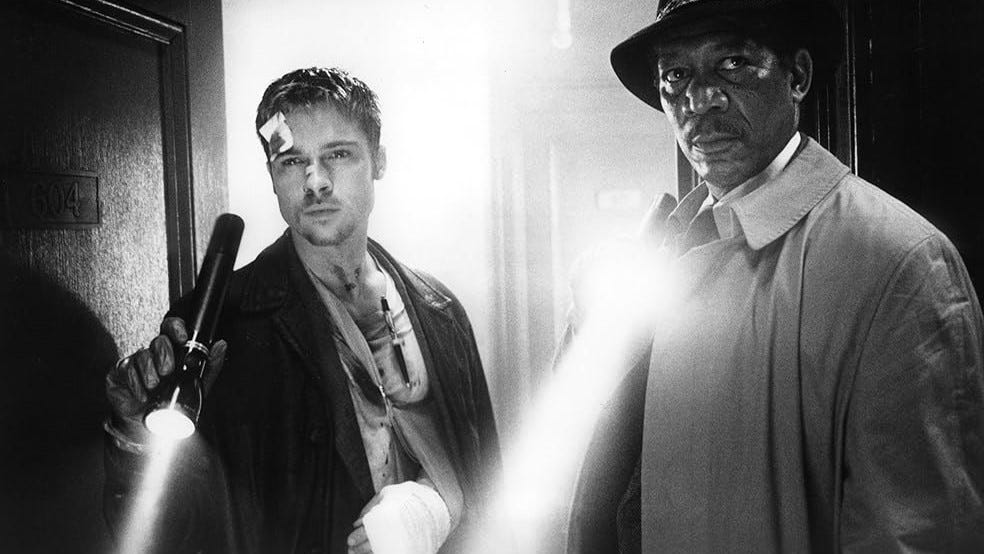
On the evening that Charlie Kirk was shot, my son came home from school and said he wanted to watch a movie. His choice was Fight Club, a film both of us love and one I’ve seen many times. I remembered, however, that Fight Club came after another movie starring Brad Pitt and directed by David Fincher that I hadn’t seen since its theatrical release. It was the 1995 film Seven (stylized Se7en on the poster)—and based on my description, he showed interest and we decided to watch it. The choice was perfect for the evening because Se7en reveals a social nihilism that was only latent in the optimistic 1990s but has matured significantly since.
The film stars Pitt and the “It Girl” of the 1990s, Gwyneth Paltrow. Pitt plays police officer David Mills, a cop newly arrived in the big city. He seeks out veteran, soon-to-be-retiring detective William Somerset, played by Morgan Freeman. Somerset refuses his new sidekick at first, but when a gruesome murder is discovered—and Somerset correctly surmises that this is the work of a serial killer and that fresh murders will follow—he and Mills become bonded to the case. Somerset is the senior officer, and the voice of moral authority for the film.
In many ways, the movie is a standard noir thriller, replete with rain, trench coats, and angst, but there is something extra in this one—something significant and ruinously dark. The murders involve odd torture and are themed around religion. The killer seeks out people who embody one of the seven deadly sins, and then the sin is used to torture the murder victim until they die. A lawyer is forced to cut off some of his own flesh to atone for his greed. A man is compelled to wear a phallus-shaped knife and assault a prostitute, all to demonstrate lust. Another man is forced to eat himself to death to atone for his gluttony. All suffer for their sins.
Eventually, the killer turns himself in—all part of a master plan to reveal the sins perpetrated by the police; specifically, we will soon discover, Mills. This sets up the final nihilistic ending, where the killer triumphs, and his view of the decadence of society is confirmed. The killer, given the name John Doe, is played by Kevin Spacey, who made a real name for himself in that period as a slack-jawed, dead-eyed psycho.
The logic of Se7en and its moral universe is revealed in three scenes.
The first is when Detective William Somerset has breakfast with Tracy, David Mills’s wife. She confesses that she is pregnant, though her husband doesn’t know yet. Somerset pauses, then tells her a story of when his own girlfriend was pregnant. He persuaded her to have an abortion, says he knows it was the right thing, and yet he still regrets it. However, he seems to have learned something: he tells Tracy that he doesn’t know whether it is good or bad to bring children into the world, but that if she chooses to keep this baby, that’s her decision; and if she decides not to, she should never tell Mills that she was ever pregnant. Paltrow and Freeman were then at the peak of their powers then, and the scene is beautifully rendered.
The second scene to consider, concerns the decline in any respect for the religious impulse as a peaceful, uplifting guide for humanity. In fact humanity has sought divine guidance for as long as it has had thoughts. The oldest tribal societies show signs of deity worship. Religions have rules, and they set boundaries on human behavior. Civilization as we know it is a religious project, regardless of what anyone else might think of a particular religion or act done in the name of religion. Seven is the number of deadly sins, and John Doe, the killer, is presented as the embodiment of barbaric practice to seek punishment for sin. The impulse to punish for sin is seen as the work of a torturous madman, because, in 1995, we were only three years past the release of The End of History and the Last Man, a thesis presented by Harvard-trained political scientist Francis Fukuyama whose most famous quote is:
“What we may be witnessing is not just the end of the Cold War, or the passing of a particular period of post-war history, but the end of history as such: that is, the end point of mankind’s ideological evolution and the universalization of Western liberal democracy as the final form of human government.”
It is comical now, from the point of view in 2025, that anyone published this, and was taken seriously. History did not stop, and liberal democracy as practiced in the West clearly has some flaws in its execution. But in 1995, John Doe’s more Dark Ages view of deadly sins was seen as a soon to be banished practice from the Middle Ages. In this heady atmosphere, the killer is presented as an evil remnant of the religious culture passing away. He is a self-important maniac. Here is how he explains himself and what he believes:
The last critical scene is at the end of the film when the depraved musings and plans of John Doe, the deadly Everyman from the religious past, comes to fruition. He is able to get Mills and Somerset to drive him to a remote location. There, a driver delivers a box to Somerset—and in it is the severed head of Tracy, Mill’s pregnant wife. She has been murdered. Mills is eventually told this by the killer. It is the killer who reveals to Mills that she was pregnant when he murdered her. The cluster of cells she carried dies with her. The killer tells Mills that she begged for her life and that of her unborn child, so she had apparently decided that she would bring the child into the world—but the killer kills them both.
Detective Mills raises his pistol. He can kill the man who murdered his wife and his unborn baby. Somerset says, “No — if you kill him, he wins.”
See this masterpiece for yourself:
Frankly, it doesn’t look like winning to get shot in the head and fall to the dirt, but that is the moral logic of the movie. For a good man to triumph under his own power and agency—to not let ‘the system’ play out—is portrayed as bad. When you’re at the end of history, there is no wrath. You let the professional handle it
It seems distant now, in the world where Charlie Kirk is shot sitting in a tent on a college campus just talking. Isn’t this what liberal democracy was supposed to be about? In 1995 the Cold War had ended, and the cultural order of the United States was setting the standard. We weren’t headed for an era of assassination. Or, has nothing changed and wrath is what Charlie Kirk’s killer visited upon him?
“If you kill him, he wins.” It should be remembered that no Clint Eastwood character would say this, and none of the films with Eastwood as Dirty Harry worked this way. No Cowboy film would use this line either. John Wayne never said those lines. In the 1970s, moral order was under siege. Eastwood would point his massive pistol at criminals and ask them to “Make my day.” The killer admits to being envious, that is his sin, and David Mills gives the killer his last deadly sin: Wrath. This was no longer to be allowed in the kinder, gentler America.
This cultural moment could not last long. History moved on rather quickly in fact. September 11, 2001, was just down the road. But it was in this period, in the 1990s, where passivity met the creeping darkness. And this made David Mills (as played by Brad Pitt) powerless. And I would ask, what man wanted this? The view of this movie is that killers are religious zealots, and the police are witless dupes, part of the problem. Was the end of history where good men had no agency what made the future female?
Is it any wonder, then, that the next film the two made, Pitt and Fincher, was Fight Club? If a man can’t fight for a just and decent society—where he becomes a father in a loving, honest marriage—then what does he have? Only his friends, if he has anything at all. Only his fellow men who’ve been left behind.
In Se7en, David Mills believes in a moral order and sees it collapsing. Tyler Durden, in contrast, largely rejects the possibility of a stable moral vision and embraces chaos and identity emptiness.
Just four years after Se7en, in 1999, two years before September 11, 2001, Pitt and Fincher gave us this:
Fast forward 30 years, and here we are. Incidences of crazed killers have wildly increased. They are not serial killers, by and large, but men who strike out at the unarmed, often children. The killers are not Christians zealots. They aren’t like like Charlie Kirk. We’ve lost the idea that our government and moral order will save us, yet we’ve retained the darkness evident in the film. Something radical has changed in our culture, and even though Se7en was made from the perspective of the Triumphalist 1990s, we’re now seeing the manifestation of the trend that was detectable then. The latent nihilism, the belief that life has no inherent meaning, and that the future will be worse than the past, is at the surface now, and it will manifest itself as more murders, before the tide recedes again.