

It has long been my view that human knowledge is not immortal—that as we gain new knowledge with each generation, we also lose some fraction of what came before. I can, for example, operate a manual clutch transmission; my children cannot. Yet they can navigate my iPhone faster and more intuitively than I can.
Some lost knowledge is trivial—like shifting gears in a car—but other losses are far more consequential. Tribal peoples long ago possessed deep, hard-won knowledge of plants and animals, refined over generations because their survival depended on it. Much of that knowledge is now gone. We can visit the home and garden department at Home Depot, the drugstore, or the zoo, but these are poor substitutes for lived, generational understanding of the human relationship to plants and animals.
There is another, deeper layer to this idea of lost knowledge: the apparent loss of the techniques required to build massive structures, and perhaps the loss of understanding their original purposes as well. Our current explanations, at the very least, appear incomplete. There are massive structures around the world about which our knowledge remains speculative, both in terms of how they were built and what they were for.
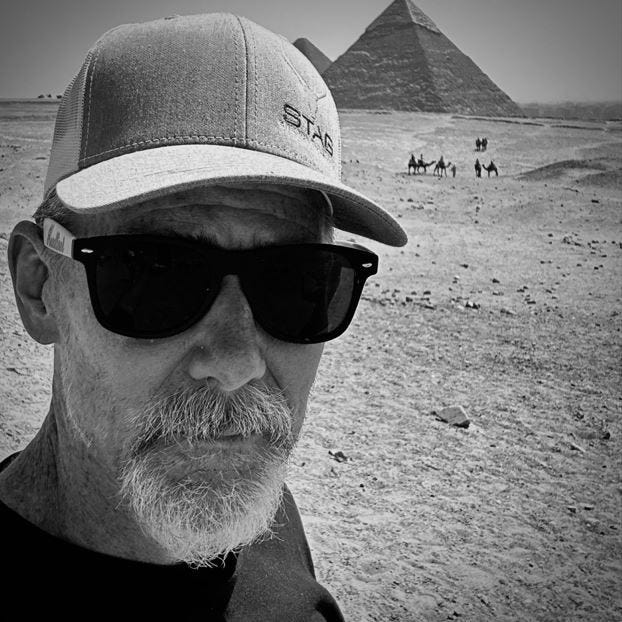
For example, there is something beneath the pyramids in Egypt that has no settled explanation. This is not speculation; it has been confirmed by multiple sources. There are chambers and subsurface features beneath several pyramids for which there is no obvious purpose, and these must be considered in the context of the pyramids themselves—structures built with astonishing precision and durability. Humanity could not construct an identical pyramid today under the same constraints, or perhaps at all.
A similar pattern appears in Mexico at Teotihuacan. These structures were not built by the Spanish after their arrival, nor by the peoples living there at the time of the Conquest. Indigenous accounts state that the city predated them; the Aztecs did not know who built it, for what purpose, or why it was abandoned. Likewise, the Egyptian pyramids were not built by the direct predecessors of the region’s modern inhabitants, who themselves were unable to construct even the Suez Canal without substantial outside assistance.
Even considering just these two sites—Egypt and Mexico—we see the same shared pattern, and no clear explanation:
• Both feature surface monuments paired with subsurface spaces—clearly intentional, not accidental, and not structurally required. If these were merely religious structures meant to bring people closer to a Sun God, a common explanation, nothing underneath would be necessary.
• Both exhibit cosmic alignment to stars, solstices, and cardinal directions. This indicates a highly sophisticated understanding of the Earth’s movements and its relationship to the stars.
• Both required extreme labor investment, far beyond what would be necessary for any “practical” building. I have been to both sites, and they beggar description. There is no building or monument in the United States—or any I am aware of from the past 500 years—that is as large.
• Both leave us with a profound knowledge asymmetry. No clear explanation has been handed down to us; either that knowledge was restricted or deliberately withheld. The form and function are not obvious, not transmitted, and not easily inferred.
Of course, there is wild speculation surrounding these buildings and many others, along with a great deal of fake “evidence” available in every form. Whole industries and movie genres have been created around alternative histories.
That evidence of the past is sometimes fabricated should surprise no one. I belong to several online groups that share historical photographs, often from World War II. Despite the existence of tens of thousands of authentic images from that conflict, I regularly see photographs that are clearly AI-generated presented as genuine. Why? Because the person posting them derives some benefit—attention, status, or engagement. Finding something new is exciting.
Fake archaeology and forged artifacts have a long and well-documented history. The holy-relic industry was once fully supported by the Christian Church, and many towns had their local favorites. At one point, there was said to be enough wood from “the one true cross” in circulation to build a bridge from Paris to Jerusalem. That most of this wood could not possibly have come from a single cross was of little concern, given what it symbolized. But if our goal is to reconstruct the past in order to recover genuine ancient knowledge, such fabrications are not harmless—they are consequential. It is exceedingly difficult, when discussing something thousands of years old, to separate signal from noise.
Still, it is clear that mysteries exist in the past, and that these mysteries represent lost knowledge. Thousands of people were involved in the construction of these structures. They saw them. They understood them. They helped build them. Tens of thousands of people must have been involved while they were in use, whatever that purpose may have been. And now those people are gone, their cultures have radically changed, and the knowledge is gone as well.
What if we could regain and reuse some of that knowledge—not through mysticism or fantasy, but through better tools? For the first time in human history, we are approaching a way to preserve understanding across generations without relying entirely on fragile cultural transmission. The internet, and now artificial intelligence, offer something no previous civilization possessed: the ability to store, cross-reference, and retrieve human knowledge, independent of memory, lineage, or tradition.
Civilizations have always known more than they could keep. Knowledge decays when it is not practiced, when it is no longer economically useful, or when the people who hold it die. Writing slowed that decay. Printing slowed it further. Recrodings have slowed it even further still. But all past tools still relied on continuity—on people caring enough, generation after generation, to read, teach, and transmit. When that chain breaks, the knowledge breaks with it.
Artificial intelligence changes that equation. For the first time, knowledge does not merely survive as static records but can be actively interrogated, recombined, and tested against new information. Techniques can be reconstructed. Patterns can be rediscovered. Lost methods can, at least in principle, be inferred rather than merely admired.
This does not mean AI is wise, or that it replaces human judgment. But it may serve as something no civilization has ever had before: a durable memory—one that does not forget because it does not age, migrate, die, or lose interest.
Perhaps one day we will be able to understand what our deep ancestors were capable of, and why. As it stands, I am not entirely convinced we have retained enough institutional knowledge to recreate everything we achieved just in the past 100 years—let alone progress beyond it—without difficulty. But with better tools, we can learn without forgetting.
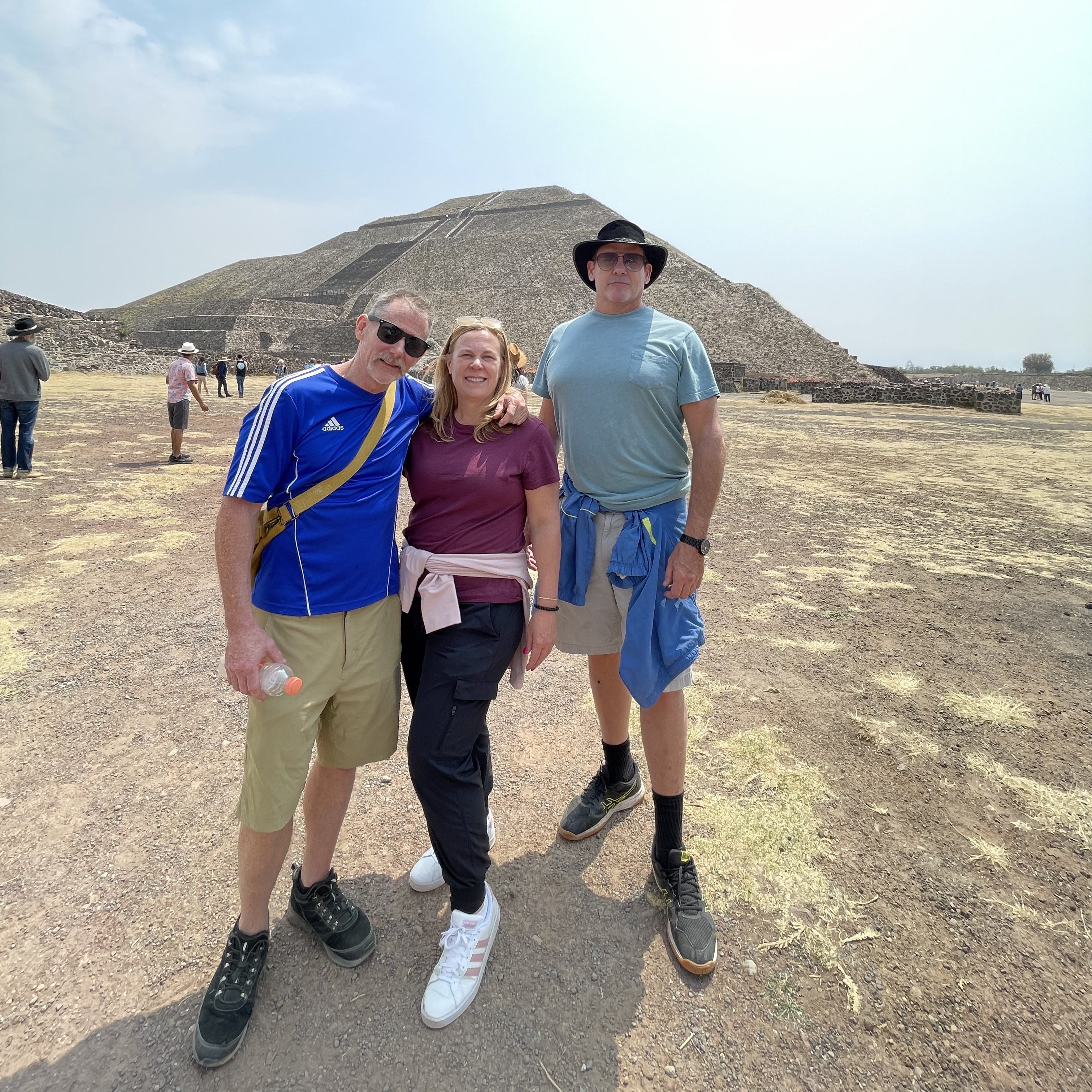
This was at Teotihuacan, and this is just one of the massive pyramids.