

Marianne Faithful
By the time I got around seeing the Rolling Stones, they were already considered ‘old.’ I saw them in New Orleans and recall thinking that I’d best jump at the chance to see the Greatest Rock and Roll Band before they broke up or Mick Jagger died. John Lennon had recently been murdered, and so there was no way I’d see the Beatles, but I could go see the Stones, and I didn’t realize I had decades of additional opportunities to see them ahead of me.
The Stones were, for a time, considered to be the threatening rock and rollers, at least compared to the boy next door Beatles. The Beatles wanted to ‘Hold Your Hand,’ the Stones wanted to ‘Spend the Night Together.’ It was during that devilish phase of the Stones that a young lady with the innocent sounding name of Marianne Faithful entered the picture.
Faithful was a lovely little pixie of a woman who fell in with Mick Jagger and the Rolling Stones when she left her husband, Peter Asher, in 1966. She recorded a song written by the Jagger/Richard team, ‘As Tears Go By,’ and it was a minor hit, but it was her association with the Stones that made her a celebrity. None of her music which followed was of note, and the downside of her time with Jagger was that she became a heroin addict and lost custody of her children.
For five decades Faithful recorded music and made several TV and movie appearances but her unhealthy habits from the days with the Rolling Stones persisted and she was in and out of tragic relationships and drug rehab centers, while Mick and Keith chugged along, spawning kids and making money. Her biography is marked by a series of illnesses and accidents and recoveries.
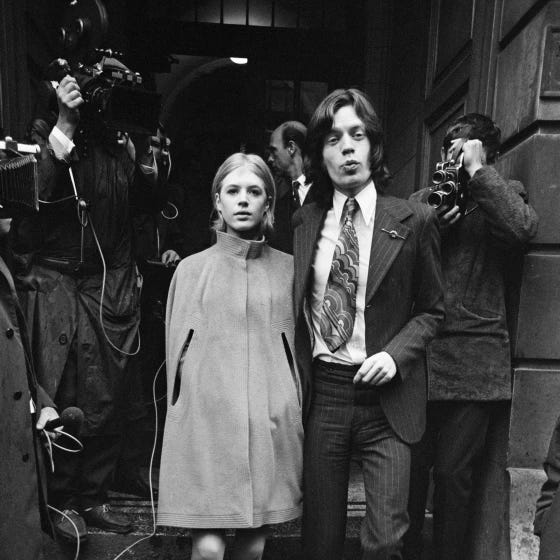
I mention all of this only because she died a few days ago at 78, and the images of her with Jagger from the late 1960s are what has been recalled of her. She was, to the end, the innocent girl with a lovely face and innocent sounding name cast upon the cruelest practices of the counterculture. The counterculture men used up women like her, and those women never recovered. The shelf life of a groupie is short, and I suspect, the regrets long.
It appears to me that Mick has changed somewhat. He became a dad again, again, at 73, 2016, and he has been taking diligent care of his health. His partying days may be over, but in his wake, and in the wake of so many of the men who became incredibly famous at an early age, there is a debris trail of broken women like Marianne Faithful. She rode celebrity for the rest of her life, but it wasn’t a happy one. The outcome of her life, compared to Jagger’s, demonstrates just how much better the counterculture was for men compared to women. ‘Free Love’ was a boon for wealthy powerful men, then as now. Women, not so much.
Rest in Peace, Miss Faithful.
Related: Excellent essay by Louise Perry on hooking up. Loveless Sex is Not Empowering
The South African Warning
I was into diversity before it was cool, and I’m still into it now that it’s for losers. And my diversity is the real kind of cool, which is the kind that doesn’t know or care if it’s cool or not. I don’t like types or identities, I like some actual people, and many of the diverse crew I’ve known a
re from other countries including, for a time, South Africa.
There was a fellow I knew in college in the eighties that was from South Africa, and I recall that he had a real quandary since he was reaching the end of his deferment from military service back home and he didn’t want to serve in the apartheid era South African military. His name was Sven, so I will assume he was of the Dutch Afrikaans and not the English variety of white South African.
As difficult as Sven’s dilemma was, the South Africans I met in the mid-1990s that had been in South Africa during the last phase of the old regime and had activity participated in ending apartheid. What happened next was something not speculated but known, and they had helped bring it about.
The two men I knew best were both Jews, and they had already seen, by 1998, what was coming for South Africa. It was not going to be a multiracial zone of peace and toleration, which was exactly what they had foreseen when they were agitating for the end of apartheid. What was going to be wasn’t sure, Nelson Mandela had just taken over and the good vibes were still there, but the trends didn’t look good.
Ralph Ziman was one of these men. He was a film and music video director living in Los Angles when I met him, and he told me a story about what he had recently seen in his home country. He said that the South African postal service was quite good and had been set up by the British. The British excelled at these kinds of civil service systems, and they had organized similar public services in India. When apartheid ended, the services were required to hire black mail carriers and there was a massive switch over in a single week when routes that had white carriers suddenly had new black carriers.
And then, the mail stopped arriving. No one knew where it had gone until the next rain, when the mail came spewing out of the gutters and drainage ditches. The black mail carriers had decided to just throw the mail away right after getting it, not realizing that a mail carrier wasn’t an honorary or racially motivated job. It involved delivering the mail, and if the mail didn’t get delivered, the whole system began to break down.
I have no way of knowing the story Raph told me was true. I can say that Ralph was a decent guy, and he never said anything bad about the black South Africans, and if you go by his movies, he has a deep love for his nation, and his fellow South Africans of any race. But I don’t have to believe what Ralph told me to see what has happened to South Africa since the end of apartheid. It has been thrown into the sewer.
Will Tanner with Tablet Magazine has the story:
When Nelson Mandela ascended to power in 1994, with his African National Congress (ANC) winning South Africa’s first multiracial election, the world was full of hope. South Africans hoped that the “rainbow nation” would turn out differently than Congo, Zimbabwe, Mozambique, and Angola, among other decolonized lands where mass violence between ethnic groups and tribes filled the vacuum of postcolonial defeat and withdrawal. To this day, South Africa has seen no Gukurahundi between its native groups nor mass slaughter between natives and Europeans.
Though it has avoided the worst outcomes, South Africa is hardly a multiracial paradise. Instead, it has trended toward chaos and internal disaster; its economy is in shambles, its once-budding space and nuclear programs are long gone. Crime rules in place of law and order. South Africa’s internal issues are manifold but can be distilled down to two categories: economic tyranny stemming from an unyielding top-down emphasis on racial spoils programs in the diversity, equity, and inclusion (DEI) mode, and anarcho-tyranny in which the government is both unable and unwilling to protect the Afrikaner, Anglo, and Indian populations from vicious criminals.
The economic aspect of South Africa’s decline is primarily a result of its post-apartheid obsession with extending the country’s cursed racial logic, this time in the name of justice and equity. Though it didn’t see the outright expropriations inflicted upon white farmers in Zimbabwe by Mugabe’s government, it has seen softer forms of expropriation and reparations. For example, as of 2024, more than 24 million South Africans, the vast majority of them Black, received welfare grants from just 7.1 million taxpayers. That 3.38-to-1 grant-to-taxpayer ratio is plainly unsustainable. However, with the leftist ANC in charge, it is part of the system now and seen as an important social justice achievement. South Africa also has an outright reparations program for victims of apartheid, another expensive tax money transfer program.
This is, of course, the worst kind of outcome when a formerly white run system becomes a newly inherited black run system. The new managers suddenly assume it that the system exists only to facilitate wealth transfer, graft, and skimming, and not, by itself, to make a society work so profits can be made on legitimate enterprises. Perhaps the new managers see that the graft will rot away the entire system and all will revert to the old systems of brute force and raw coercion, but generally, they don’t act like they notice such things. They ride the inherited system into the dust. They may level out a bit, once the profits have gone into terminal decline, but it’s late by then, and there isn’t enough left of the ancient regime to make it worthwhile for anyone else to come in and restore the former system to its glory, either with black or white management. The old apartheid system was unfair, but it built South Africa into a modern nation. The wealth wasn’t shared equally, but there was wealth. The current system is simply eating the seed corn away. Over a long enough timeline, this process will result in a South Africa entirely deindustrialized and returned to a pre-modern state.
By pre-modern, I don’t mean peaceful farmers living off the land. Pre-modern or post-modern often means rule by force, violence, and coercion as the resources become scarce and force is how goods are distributed. South Africa is just about there:
Economic woes are just part of South Africa’s problems. It also suffers under a significant and ongoing crime wave that the state is both unable and unwilling to handle. As of 2023, South Africa was the most crime-ridden country on the African continent, beating out even Somalia for that dubious distinction. Most of its once-sparkling cities are uninhabitable due to crime that the state refuses to stop. The resulting state of lawlessness can rightly be called anarcho-tyranny.
Armed, illegal miners called zama zamas run extensive operations in full view. Copper cable thieves are rampant and exacerbate Eskom’s B-BBEE woes. Private security forces are now a necessity for those who want to stay safe, as the police can’t or won’t keep citizens safe from robbers, burglars, rapists, kidnappers, and murderers.
Another of these South Africans I met was an entrepreneur named Ronnie Apteker. Ronnie was a shy, soft-spoken guy prone to deep philosophical thinking. He gave me a book he wrote called ‘The Progress Paradox,’ which outlined his observation that technological progress never seemed to allow humans to rest. Labor saving devices simply allowed humans to fill their days and hours with other kinds of labor, often making them busier than they had been when labor was slow and, well, laborious.
And Ronnie was busy. He and his brother and a few tech friends had started the first internet service provider and subsequently sold it to the national phone company. This made him rich, but by then, in 1998 or so, he could see what South Africa was going to be, and he had a lot of money in rand which is the national currency. He decided that what he wanted to do was to use the money in rand to make a movie in the USA, which would be both funded in dollars and be a cultural product of the United States. Ronnie and his friends had a script, but what they need was an American to rewrite the script and americanize it. This is what they hired me to do, which I did. The resulting film is called ‘Purpose,’ and the lead character is a thinly veiled Ronnie. When Ronnie sold his little company to a big company, he got rich, but to him, the new company was only about making money, and the little company had been about using technology to change the world.
Bear in mind, I was working on this in 1999, when the internet was still new and made up of just websites. The founders of the web-based internet were young, and many, including Ronnie, were highly idealistic about what the internet would do. The script for ‘Purpose’ was the tale of a start up getting bought out and losing its ‘soul.’ That’s what Ronnie wanted to make a movie about, he had the money, and so he made it. My name is on it as an additional screenwriter, and I’m quite proud of it. In the US, it was released as a Showtime movie, and it’s still available streaming in a variety of places.
Neither Ralph nor Ronnie lives in South Africa any longer, but they have been there quite a bit over the years, often to make movies. The dominant theme of their movies is crime in South Africa. Neither, however, have made a movie about the final stages of unraveling the promise, so often promised by Nelson Mandela, of a multiracial South Africa. Out in the countryside, the white South Africans, people like my old friend Sven, are targeted for torture, rape, and the most brutal of murders. Both blacks and whites were born in South Africa and have as much claim to being African as black kids born in America have to be American.
But the South Africa of today is simply not safe for anyone, particularly the remnant white population:
The worst of the crimes under which South Africans suffer are the farm murders, in which African criminals use equipment, including signal jammers and automatic weapons, to break into isolated farmsteads and torture, kill, rape, and rob the predominantly Boer inhabitants. These attacks are known for their brutality, with atrocities like drowning children in boiling water and gang-raping female victims being close to the norm rather than radically atypical. Similar atrocities are inflicted on other South Africans, including children.
The horrific murder of 79-year-old farmer Theo Bekker and the assault on his wife serve as a telling example of what happens in these stomach-churning attacks. In Mr. Bekker’s case, at least four thugs broke into his farm stead and demanded guns and money. They then bludgeoned Mr. Bekker on the head with an iron bar and slit his throat with a knife, killing him. They tied up his wife, suffocated her with a plastic bag they put over her head, and then assaulted her numerous times. Fortunately, she survived.
Another example of the brutality of farm attacks comes from a survivor who wrote in 2001, “The first time I was attacked was in August 1998. I came back home and parked my van. My boy said there were three people looking for work. I said I only want one, and I went out to meet them in the garage. They said they wanted work, but then one with a revolver signed to the other one, who grabbed my boy; the first one pulled out his gun, but it jammed. I grabbed a broom and hit him, and then the other one, and then I ran inside to get my gun. But they knocked me down and fractured my skull, so I was unconscious. They chased my boy, but the dogs went after them, and they ran out. The fellows from the farmwatch picked them up on the road. They shot one, arrested another, and the third one later gave himself up. But all three later escaped from the police cells.”
And so, it carries on, day in and day out, as South Africa eliminates the society that existed before 1994. If Nelson Mandela is the South African Martin Luther King, then it is the betrayal of Mandela and King that might be mourned along with the thousands and thousands of dead. Most of the dead in South Africa are black, and 100% of the leadership has been black since 1994. In the US, crimes perpetrated by black killers against other black citizens are a statistical fact, and the cities with the highest level of black-on-black crime are led by a black mayor, a black police captain, and a mostly black city council.
But this fact doesn’t keep the same people beating the same drum in both countries.
It seems clear that post-Mandela South Africa is in a state of disaster that seems likely to get worse. In public life, tyranny reigns as the government enforces race-based mandates on companies that are suffering mightily under the burden. In private life, the government levies taxes to pay for welfare programs, but otherwise, it is largely absent as criminals cause an immense amount of suffering and are rarely stopped by the police. Meanwhile, politicians like those in the EFF encourage criminals to engage in more crime as a form of punishment or reparations for apartheid. All of these localized disasters stem from the decision to continue putting race at the center of post-apartheid South African life and thereby producing a photo-negative version of the past, rather than trying to build a new and better society.
Sadly, America has flirted with following the same dark path as South Africa. America suffered months of riots in 2020, much as riots racked South Africa in 2021. In America, as in South Africa, armed civilians had to defend their property when the police couldn’t or wouldn’t do so, while leftist politicians encouraged the rioters. Just as farm attacks go unsolved because of police incompetence and unwillingness in South Africa, murders are now only solved at about a 50% rate in America, the worst in the Occident. Some cities, such as Kansas City, have plummeted to under 40% clearance rates for homicides. Additionally, as robbers and farm attackers in South Africa, gangs in America are now using signal jammers to assist in burglaries.
Race is not a determining factor in national outcomes, but culture is, and not all cultures are equal in all things. South Africa and black America have much in common, including a habit of consuming the system they inherited. Not every institution succumbs to this trend. The US military, for example, has channeled black energy and competitiveness towards excellence, as have other American institutions, but the trend, the inclination, is always there. The hostility and resentment in the black populations need only be mixed with power and the toxic ideologies of collectivism to produce the slide that ends in savagery and tribalism.
I have not been in touch with Ralph since the early 2000s, but I have exchanged messages with Ronnie. After making a few documentaries in South Africa and sponsoring some stand-up comedy shows (he loved Dennis Miller), he moved to Ukraine where he lives with his wife and child in Kyiv.
The future for multiethnic societies doesn’t have to be horrific, and where I live, in Houston, I sense a harmony that wasn’t present in the land of my birth (Floribama area) or youth (Los Angeles). Overall, the USA is doing better than any other nation in absorbing other cultures and making a coherent whole. But it takes an act of will and leadership, as well as a common sense of purpose, and some good luck, to get such a society to function. South Africa is lacking in all those things, and while they may acquire these attributes, I wouldn’t bet on it. Neither Ronnie nor Ralph will be living there full-time anytime soon.
Please do read the article for yourself here
A GPL-1 Update
If you tell me what you want to eat, I will find an expert to endorse your diet. Billions are spent on dietary research, and we still can’t agree on what to eat. However, whatever your diet, there is consensus that we should be eating less of it. Marketing messages recently focused on the idea that one could be ‘healthy at any weight’ have drifted quietly away because suddenly, it’s become a lot easier to be lighter, thanks to GPL-1 meds.
My favorite professor, Chat-GPT, explains their function like this:
A GLP-1 (glucagon-like peptide-1) agonist works by mimicking the natural GLP-1 hormone, which is released in response to food intake. It helps regulate blood sugar and appetite through several mechanisms:
Enhances Insulin Secretion – Stimulates the pancreas to release insulin in response to high blood sugar.
Suppresses Glucagon Release – Reduces the release of glucagon, a hormone that increases blood sugar.
Slows Gastric Emptying – Delays stomach emptying, leading to prolonged satiety and reduced appetite.
Acts on the Brain – Reduces hunger and promotes a feeling of fullness.
So, these drugs make it easier to eat less, so regardless of diet, the body starts consuming fat to generate energy. There are no true changes or commitment to doing anything difficult, like eating more vegetables, or cooking with better ingredients, or pushing the body with exercise.
This sounds like good news, and it is. Losing weight is good, and it looks good, and it has enormous benefits. But that’s not the whole story. From Medical News Today:
Upon analysis, researchers found that participants who took GLP-1 medications experienced significant neurological and behavioral health benefits, including a reduced risk of substance addiction to alcohol, cannabis, opioids, and stimulants, compared to those taking traditional diabetes medications.
Those using GLP-1 medications also had a reduced risk of seizures, suicidal ideation, self-harm, bulimia, and psychotic disorders such as schizophrenia.
It appears that these drugs effect the regulatory systems of the body and allow the user greater control. Which is good for people who struggle to contrail their urges. But is there a downside?
On the reverse side, researchers found GLP-1 use was associated with an increased risk of gastrointestinal problems, including nausea, vomiting, diarrhea, and, in rare cases, paralysis of the stomach.
Scientists also found a link between GLP-1 use and an increased risk of arthritic disorders, pancreatitis, sleep disturbances, hypotension, and nephrolithiasis, normally known as kidney stones.
So, yes, if you can’t control your eating by yourself, and you rely on a drug, then you will suffer complications that are all avoided by regulating your mouth by yourself, as well as the rest of your impulses, and that doesn’t even address the benefits or hard, tough, sweaty exercise that pushes your body to the edge.
I work with two people who are on the shots, and they have lost substantial weight, one lost over 100 pounds, and the result is impressive. Losing 100 pounds is such a great benefit that it is barely worth mentioning the downsides. But this person still has the same infatuation with food and fancy restaurants, and I suspect, the weight is coming back. The other person is in a destructive marriage, and I suspect she, too, will eventually go back to the same behavior because a drug is not the same thing as fixing problems, addressing destructive habits, and applying individual will to life’s many challenges.
Being overweight is a death sentence, full stop. Triggering the insulin cycle over and over is a terrific way to get ‘Type 3 Diabetes’ which is a new and sober way to describe dementia. Right now, the GPL-1 agonists are helping millions to lose weight, but building up the human agency is the prime method by which better outcomes should be generated and I’m watching the Ozempic trend and waiting for documentary evidence of what ‘cheating’ does to emerge. We’ll see. I can control my food without drugs, and it’s a better way to live.
The larger question is whether GPL-1 drugs are so good, and weight loss so critical, that these drugs will be paid for by Medicare, or even distributed like fluoride and iodine. Most people in contemporary society are failing to control their food urges. Food is ‘hyper-palatable’ and therefore, irresistible to many. Food makers know there is a deep, evolutionary bias toward cheap, easily available carbohydrates, and so there is a basic choice to make. Allow these foods to be sold but also allow the drugs to be widely available to combat the effects of the food, leave people to their own devices when it comes to food, or limit the availability of the drugs and the food.
In the end, people must seize control of their urges cold turkey, or they will lose something else elsewhere.
Read the Medical News article here
Messy
I’ve accepted that much of the music I like, outside of country music, will have a heavy foul language component. The trend is not contained in hip-hop music alone. Music of the ‘trip-hop’ trends that I like, often the product of the Brits, has a high bad word count and is made by and about the dwindling white working class of that country. I find them to be interesting in a way that the working poor of the USA aren’t. But then, I loved the movie ‘Trainspotting’ back in the day too. Those crafty Brits make poverty look a little less pathetic.
Along those lines is this song by Brit songbird Lola Young. Much of her music falls into the category of ‘hate songs’ which stand in contrast to the many ‘love songs’ of the past. These songs are typically about abusive relationships, and hers is a classic of the genre, and when she states -
A thousand people I could be, but you’d hate the fucking lot.
… there is a universal longing there. Some relationships are futile, and she captures the details of that kind of human foible perfectly in this little gem: