

Real Fake History
It is entirely understandable that the generation called the Millennials are the most jaded Americans in living memory. They came of age just as the internet was replacing the real world as the preferred destination of childhood afternoons, and as young adults, many of them graduated from high school just as the 2008 financial crisis made the job market the hardest to enter in decades. They’ve been smeared as the cry baby snowflake generation since then, though that has not been my experience with the Millennials I know. I’ve found them to be tough and resourceful and cold-eyed realists in many cases, though I deal almost exclusively with Millennial men.
On several occasions, however I’ve heard these same Millennial men voice skepticism that the moon landings in 1969 were real. Apparently, some portion of that generation, and possibly the ones to follow, don’t believe there is greatness in our past, or present. A Millennial engineer in my office openly scoffed at the idea that we accomplished the moon landings. Skepticism shows through in their hesitancy to believe in the heroic achievements of the past.
“Did we really do that?” he asked, in what I think was all seriousness. “Really?”
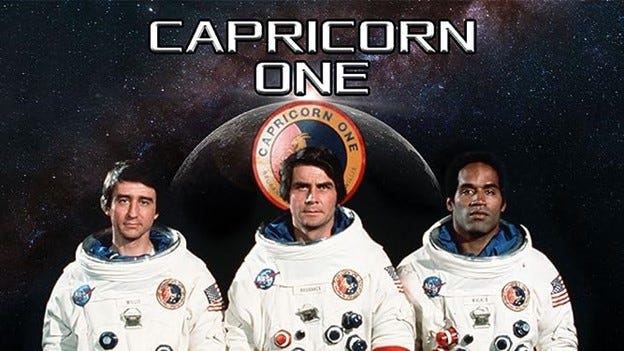
This reminded me of a movie I saw called ‘Capricorn One,’ a film released in 1977 about the US government faking a landing on Mars. The movie was not good as I recall, and it was released the same year ‘Star Wars’ came out, and so it is largely forgotten. But even then, the idea that the US government would fake a massive event, like landing on another planet, was in the culture. The skepticism was there, just eight years after the actual moon landings.
It is said we’re ‘going back’ to the moon and so perhaps one day, enough people will have gone to space in living memory to convince those that don’t go that the original moon landings were real. Maybe the new astronauts take photos of themselves with the freaky golf cart the last astronauts left behind. Since the moon landings happened in my lifetime, I’m sure they happened, but as a measure of American faith in government, that fact that so many adult men don’t believe we ever even went to the moon doesn’t bode well. The era of great achievement, and faith in the efficacy of the US government, is gone and has been gone for generations. It will take a real Mars landing to get it back.
Who Owns the Global Baby?
The hardest part of staying young is suppressing the memory of the past. The truly young have no such problems, but even a very fit man (such as myself) must live with the burden of knowledge that accumulates from having lived through previous eras. One of the many eras I lived through was the one where humans were created by men and women having sex, and with any good fortune for the child, loving that child and raising the kid together. That is my story of origin. My married parents made me and loved me, and my sister. I miss them greatly.
That is not the origin story many, and eventually most, have or will have. The new way to make a baby involves summoning the baby from its parts. Some semen here, an egg over there, a host uterus, and we have the customized baby. The semen might come from Italy, the egg from Vietnam, and the uterus from Africa. This is the global baby.
Leaving aside the incredible ethical issues of a global baby, we turn to the many legal issues. Having paid my share of child support, the idea of a parted-out baby certainly caught my eye when I came across an article published on The Upheaval Substack written by a fellow named Jeff Shafer. He describes his purpose this way:
British ethicist Oliver O’Donovan once wrote in passing of “a position too familiar to technological society, that of having achieved something that we do not know how to describe responsibly.” In what follows, I would like to attempt such a description, specifically as to the technocratic project of human reproduction that now confounds historic American family law. Under the influence of this tech novelty, contemporary family policy is trending toward standards and defining precepts that deny or refuse roots, nature, and limits of any kind—embodied or otherwise—classifying these as normatively irrelevant inconveniences to be technologically overcome rather than contemplated, honored, and lived in.
Shafer notes that children, and the law surrounding them, are ‘radically relational,’ meaning they are bound up in their hereditarian descent. They have a mother and father who created them and presumably will, or should, even if forced, care for them. All law descends from this premise. Babies are part of families, both small and large, and societies are made up of groupings of families. An individual without a family would never be a baby, so the law around children presumes there is a responsible adult present. This has been the set of legal assumptions since this has been how babies reached the world. Babies who lost their families still had them, and so extended family would step in, realizing their moral responsibilities, and lacking that, the state does whatever job it can. Or the baby is abandoned and dies. This has been far too common, even recently.
What facilitates these situations is the science behind ART, which stands for Assisted Reproductive Technology, and because this process involves the twin gods of science and technology, it is assumed that this is a good thing, and ask anyone in this industry why it’s a good thing, the chances are good that the answer will be that it allows otherwise infertile couples to have children. And this is true up to a point, and one of those points is where the global baby requires legal frameworks, otherwise unheard of, to be made possible. Once such framework is the ‘gestate and release’ contract in which a woman is employed to gestate a child, not her own, and then release the results of her labors to the contract owner. This, according to Shafer, is the ultimate reductionism:
In terms of its biotechnocratic and consumerist framework, the child comes into the world not naturally related to anyone, but only transactionally connected to the persons responsible for summoning him through purchase or technique, or other effort the law may ratify.
What results is not a child of any of the traditional human impulses that make a child and relate the child to the parents. It wasn’t love, lust, two bottles of wine, or even a rape that serves a sexual or power need. What is left is this:
But the new legal model on offer proceeds by describing the child instead as a raw datum, ontologically isolated and absolutely individual—without a history and without a certain home—until the happenstance of a managerial adult choice intervenes.
The ‘nature versus nurture’ debate rages on and at any given time, one or the other ideas become dominant. There was a time, after WW2, that the nurture debate was leading, and this idea was summed up in the work of Hannah Arendt and her ideas around the ‘banality of evil’ and in the experiments where it was supposedly shown that under the right circumstances, normal Americans would administer horrible shocks to test subjects. All of this this was in service of the idea that any of us could have been evil Nazi camp guards under the right circumstances. We democratized evil in the service of allowing government greater latitude to put restraints on a society of would-be monsters.
There was a concurrent movement that promoted the idea that some people had conditions that they couldn’t control and therefore couldn’t be blamed for the outcome. Alcoholics, or drug addicts, or those with mental illness were strictly the victims of natural conditions. Addiction wasn’t the product of bad character, or even crappy parenting. It was a disease state, and only the right health care professionals could treat these terrible maladies.
Both ideas were precursors to severing the ties of parenting to the outcomes their kids achieve. If they turn out bad, it’s either because they were born defective, or they were trained to be that way. There were plenty of ‘family or origin’ blame to pass around, but as the therapeutic state took over the role of parents, and parents were relieved of any consequence of producing a bad child, or even the consequence of having no children at all, since the state handled elder care, then it was only a matter of time before parenting became strictly transactional.
And so here we are. Kids are commodities, and ART makes it a business, which puts us at a crossroads. Who will these kids be as adults if their origin story is one of overlapping contracts and assembled pieces?
To summarize and conclude: In the vision of the Technium, as well as in those precincts of the law that have absorbed the machine logic as its own, children are radically homeless. That is to say, the child is understood as conceived and entering existence without objective relation to anyone, and thus is without a proper claim to a particular family or to the love and care of those persons whose maleness and femaleness in unifying relation was responsible for the child’s existence, identity, and characteristics. As such, the child has no default placement, no security of embeddedness, no people, no ancestors, no family history that the child is extending.
We might say that what this means is that the initiating condition of human arrival in the world is as orphans. But that would be wrong. It’s much worse than that. An orphan, by that very classification, is reminded that he lost something vital, and he (and we) are allowed to lament that loss. But in terms of the new techno-anthropology, there is no recognition that the child ever had anything to lose, and so there is no reason or permission for lament—or even for the category of “orphan.”
Under the old conditions, we would, if things worked out great, all be orphans eventually. I’m an orphan, as my parents died years ago. But I have a sister, blood related to me, plus cousins and aunts and uncles, and tubs of pictures and documents I protect because they are part of the family history. Parted together kids don’t have any of that. They are halfway to being in the state of the ‘replicants’ which were ‘created’ adults from the movie ‘Bladerunner,’ and these humans were driven mad by their lack of authentic connection. To subdue them, they were given fake families and fake memories. But this, too, was unsettling. They figured it out eventually, and that left them empty, angry, human vessels. Having the knowledge of their own commercial origin, they were dangerous, so they had to have programmed within them a finite life span.
ART takes us in this direction. It is not impossible to imagine a dying civilization creating humans this way to stay alive. A global baby can easily become the state’s baby, and many will become wards of the state as commercial transactions fail.
Babies are products of humanity and parting them out is a dystopian outcome as I can imagine. Not having kids is not a tragedy. Billions of people have entered those circumstances by choice. But piecing together humanity from the constituent parts is a humanity far different from the one I remember, and I prefer my burdensome memories to what’s coming.

Little Bill
Gene Hackman died recently, and I am reminded of the final scene from my favorite (one of many) movies, ‘Unforgiven.’ The story concerns a reformed gunman, William Muny, who is pulled into a scheme to get paid by some whores in Montana who’ve put a bounty on the head of a couple of cowboys who abused them. Muny and his friend Ned are pulled into this plot, and as Muny, Ned, and a newcomer, The Kid, travel north, Muny’s horrific past as a killer is recalled. Muny has changed, he says, due to the love of his recently deceased wife. But when Little Bill, the local sheriff of near equal brutality, kills Ned, the old William Muny, the one only spoken of fearfully, returns, and he makes one appearance in the whole film, at the end. He shows up at the saloon to kill the bar owner of the ‘shithole’ as he calls it for humiliating the corpse of his friend Ned, and he’s come for Little Bill, brillantly played by Gene Hackman. Clint Eastwood and Gene Hackman made many of my favorite films, and here they are together, walking into American film history:
Note that Ned was played by Morgan Freeman, who is black, and the film never veers in that direction. By 1990, it was possible to make a film where two friends could be white and black and not yammer about it constantly. No one had to apologize. The same is true about ‘Million Dollar Baby’ another Eastwood masterpiece.
RIP Gene Hackman, and thanks for the memories.
LINK OF THE WINK:
South Park is the gift that just keeps on giving. I was listening to Marc Andreessen this week, as I do whenever I find an interview he gives, and he was talking about how many ideas and business plans are like the Underpants Gnomes on South Park, who have a three-part plan:
Steal Underpants
?
PROFITS!
Pitch perfect, and funny because it’s true.