The jury is still out on the long-term health effects of GLP-1 agonists on those who take them. Certainly, many people lose weight, which is obviously a good thing. Obesity is not an aesthetic preference, and no one is simply “fat” by choice or by birth. Natural selection would bias strongly against a chronically obese phenotype, at least in the modern sense of obesity. The health effects of massive “overfeeding,” as the literature calls it, are well documented.
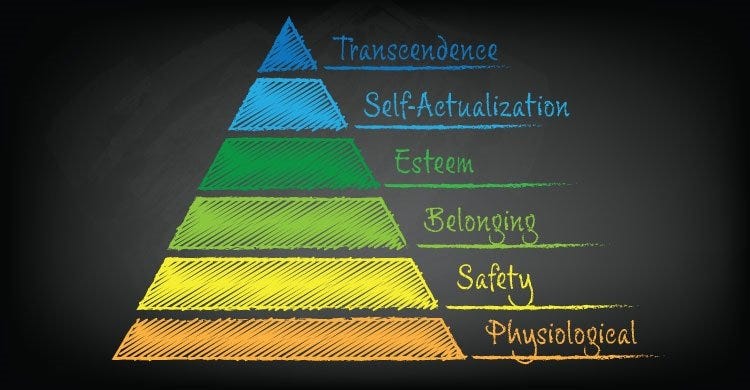
The broader fact is that the overabundance of calories should be recognized as a tremendous step forward for humanity and a triumph of human ingenuity. The first order of business for any human society is securing enough calories to survive. Today, for most people in most places, that problem has been largely solved. There is plenty to eat, and the first pillar of psychologist Abraham Maslow’s hierarchy — basic physiological survival — is within reach for nearly everyone.
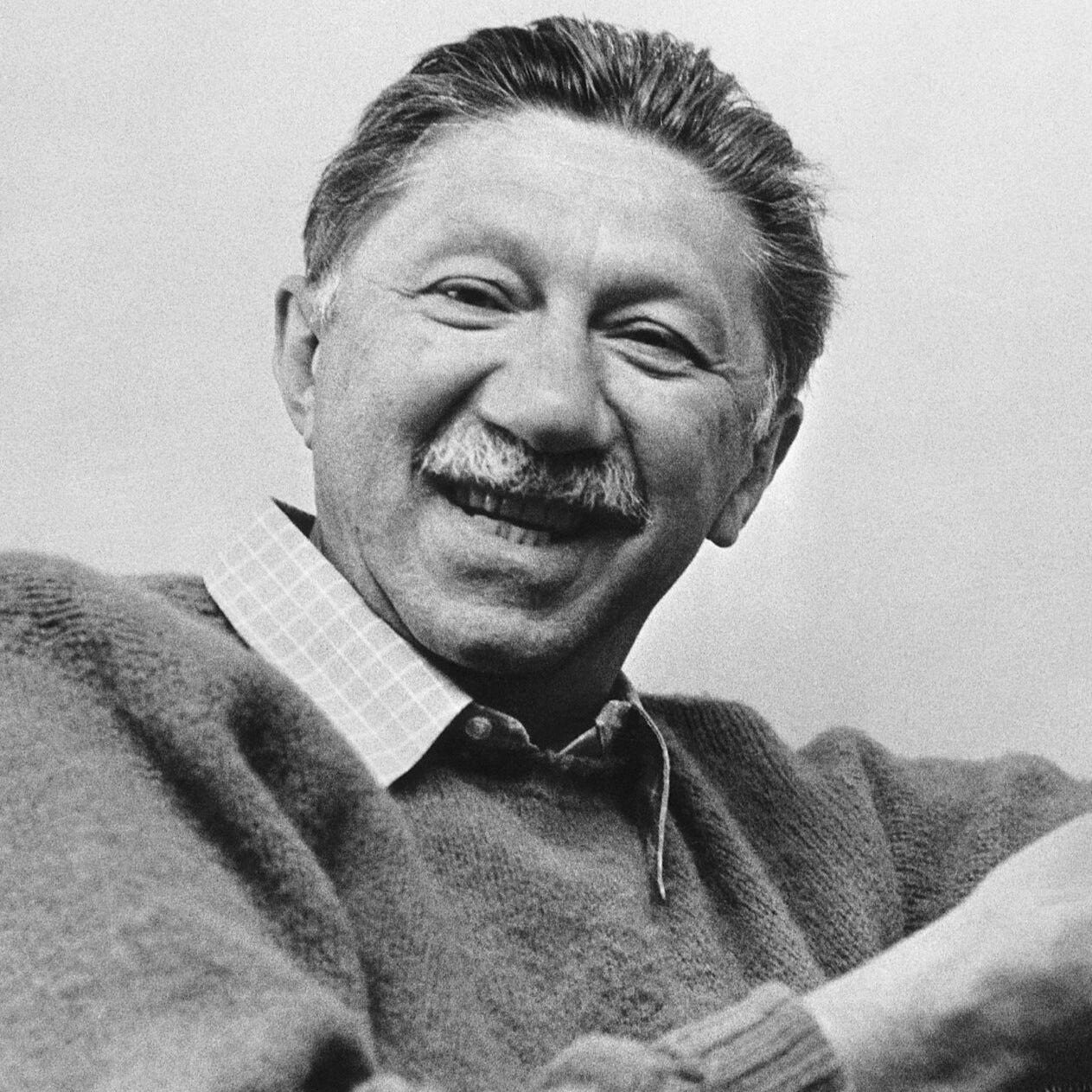
Abraham Maslow was born in Brooklyn to Russian-Jewish immigrant parents. He initially studied law before turning to psychology, where he began with research on primate behavior. He later taught at Brooklyn College and Brandeis University, emerging as a central figure in the Humanistic, or “Third Force,” movement in psychology, which emphasized human potential, creativity, and healthy functioning rather than pathology alone.
Maslow observed that the two dominant, non-religious models of human behavior that had preceded his generation — Freud’s theory of dark repressed desires and Skinner’s behaviorism, which treated humans as elaborate stimulus-response machines — failed to account for the higher, more aspirational parts of the human personality. Some people genuinely seemed to strive to grow, to learn, and to do well in the world. What explained this phenomenon? Maslow set out to answer that question.
As a first observation, he noted that hungry people cannot aspire to much beyond getting something to eat, and incredibly, as noted, that basic need has now been universally met. Where it remains expensive to procure food in adequate quantity, one can be sure the constraint is political rather than agricultural or scientific. Scarcity is now an artificial choice.
Of course, man does not live by bread alone, but the other requisites at the base tier of Maslow’s hierarchy are also widely available. This first pillar includes food, air, water, sleep, warmth, and shelter. If we set aside air and sleep — which require no capital, no expertise, and no supply chain — it becomes clear that food, water, clothing, and shelter constitute the core material requirements for human life. On all of these fronts, conditions have dramatically improved: they are cheaper than ever, widely available, or — in the case of food — limited only by political or regulatory barriers rather than any real scarcity of production.
With the physiological layer largely conquered, what comes next? Maslow’s second pillar consists of physical safety, predictability, law, order, economic security, health stability, and protection from chaos and predation. You could collapse this entire list down to “law and order,” which is where civilization begins. You cannot have philosophy or art if bandits or warlords are tearing through the countryside every six months. Health stability itself depends on legal institutions capable of settling disputes without violence — matters that, in earlier eras, would have been resolved by bloodshed. Nations rise or fall on this pillar.
Most places on earth now possess at least fragments of these institutions, though unevenly and subject to constant fluctuation. Still, relative to the past, there is now more law, more regulation, and more enforcement than ever before. One may dispute what constitutes justice — China and the United States offer two wildly different examples — but there is nearly universal agreement that rules and adjudication are superior to chaos.
Once survival and security are in hand, the human organism wants community. This is Maslow’s third pillar, and it manifests as friendship, romance, family bonds, group membership, and social intimacy. Here we find that the abundance of Pillar One and Pillar Two can work against Pillar Three. Yet, as with so much in the modern world, the bottleneck is not scarcity but habit. Many people have replaced in-person community with virtual community, but this is a choice, not a necessity. By modern standards, hundreds of online “friends” have replaced three actual friends — a kind of malignant abundance. Yet the existence of bowling leagues, book clubs, church groups, gyms, and dance halls testifies that the requirements of belonging are easily satisfied if one bothers to show up. Most people still have extended family. Romantic belonging is equally abundant; the dating apps have seen to that. There is no shortage of sexual opportunity on the internet.
Once food, order, and a community of some sort, the next desire is to matter within it. Maslow’s fourth pillar includes status, achievement, mastery, reputation, respect, and dignity. Again, the abundance of the lower pillars creates a surplus of opportunity here — though not always of the healthy kind. Nevertheless, if one wishes to achieve mastery over a subject, there has never been a period when more material, instruction, and training were available. Information is now effectively free. A person can build a reputation, gain respect, and recognize his own dignity in ways that a serf, slave, tribesman, or frontiersman never could. One can learn a subject, achieve mastery, and broadcast the fact of that mastery with greater speed and efficiency than in any prior era.
Which brings us to Maslow’s crowning intellectual insight into human longing: the fifth pillar, self-actualization. At this level, the human animal seeks not merely to be effective but to be authentic — to pursue personal growth, creativity, meaningful work, and the fulfillment of potential. This is the layer at which Maslow believed the species was “half-finished.” In his view, most humans never reach it because lower layers perpetually yank them back down. Even in free and wealthy societies, actualization is rare, just as independent thought and virtue have always been rare.
Yet the ability to reach the top tier is now available to more people in more places than at any point in history. We are poised to reap the cumulative benefits of centuries of progress. Law, economics, culture, and technology have placed humanity in the best position it has ever occupied to produce self-actualized individuals at scale.
When Maslow conceived this hierarchy, the world was far less abundant and was engulfed in the most destructive, life-devouring war in history. Yet in 1954, just nine years after end of the bloodletting of World War II, he published Motivation and Personality, which formalized the hierarchy of needs. The lower tiers have never been easier to fulfill; the higher tiers are now within reach to all.
The agricultural revolution that began millennia ago provided calories and nutrients in unprecedented abundance. The industrial revolution replaced human labor inputs to a degree that no slave system could ever match, spreading the benefits of manufacturing along with rights, wages, and leisure. And the digital age has provided education and information in such quantities that no subject, technique, philosophy, or event is beyond the reach of nearly anyone on earth.
All of these positive trends must be considered beneficial even before the next wave of technology arrives. What artificial intelligence, robotics, new forms of energy, incredible breakthroughs in health, and massive reductions of friction in the world monetary system will deliver will be at least as transformative. Millions will use these revolutions to climb higher on the hierarchy of needs. Others will use the same tools to sabotage their own progress — and sometimes the progress of others. Still others, like the terror networks that use the internet to coordinate mass attacks, will seize these tools in an attempt to impose their narrow visions on the world. If history is our guide, the schemes of the world’s most malignant rarely succeed in the long run.
This brings us to the final phase of development that Maslow articulated later in life. He added a sixth pillar: transcendence. This is the level at which the individual seeks experiences that are spiritual, devotes himself to something beyond his or her own ego, and experiences moments of unity, awe, faith, and truth. At this level, we may return to the ancient pattern in which humanity gazes with wonder at the universe and — even with full knowledge of how it works — marvels at its beauty and coherence. Here Maslow converges with the mystics of many religious traditions, including Buddhist, Christian, and Taoist contemplatives. Our advances will, according to Maslow, lead us back to our starting points, but with far greater knowledge. It won’t be just the priestly caste that reaches a transcended appreciation for the beauty of this world.
Because the path to the higher levels of human experience is so much easier to reach, there has never been a greater moment to be alive. The potential of humanity has never been more expansive than it is today, and billions of people now enjoy opportunities that no one possessed even a century ago. The time to celebrate and embrace what we can become is now. Humans created this world of abundance, and it is humans as well who obstruct its proliferation. Yet the last obstacles can be overcome, and we can advance faster and further than at any time in human history. Actualization and transcendence are possible for billions of people who need only embrace their higher nature to make their lives and the lives of so many others better than ever.