

I’ve written here, and elsewhere, about the falling fertility rate around the world. The first hint of what was coming I picked up on in the pre-internet era, in stories about the Japanese, which I initially associated with a broader cultural eccentricity—their penchant for anime, manga, and other symbolic representations of sex.
But over time, it became clear that the phenomenon—if that is how one chooses to define it—had spread to Europe and is now the prevailing trend across much of the world.
The issue returned to the top of mind again recently with the death of Paul Ehrlich, the Stanford professor who wrote The Population Bomb, a catastrophically wrong prediction that the world’s population was rising faster than the food supply and that, from the vantage point of 1968, the 1970s would be a decade of starvation. Ehrlich maintained his faith in his own prediction, in spite of all contrary evidence, up until the very end. A learned man and his idiocy are hard to part.
From a spectacular post by Mark Manson, available here, I learned of Malcolm Caldwell, a British professor who was murdered in 1978 in Cambodia by the very regime he had come to praise. There was already ample evidence by that time that a bona fide genocide was underway, but Caldwell—well known as a radical Marxist—showed little interest in such details. He, predictably, met his end in Cambodia:
Once there, Caldwell toured the country. He met the leadership and learned about their policies firsthand. But the climax of his trip was the last evening — a private audience with Pol Pot himself. Reportedly, Caldwell was “euphoric” with excitement and anticipation. Once in private, Caldwell and Pol Pot had a long intellectual conversation. In his enthusiasm, Caldwell began sharing some of his ideas for the Cambodian regime. He began to offer feedback and dare I say, potentially even a little criticism. Pol Pot, not used to being lectured to by a professor, promptly had Caldwell killed that night.
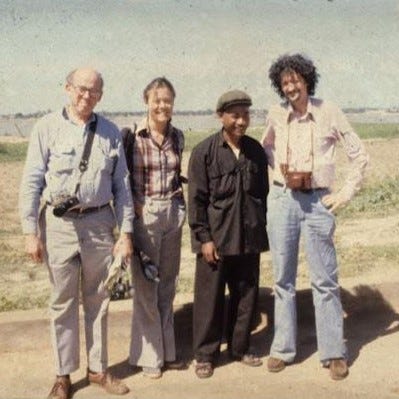
That is Caldwell on the right in the picture above.
A little digging will produce additional details about the death of Malcolm Caldwell, but there is no disagreement about the essentials: the method (gunshot), the place (Cambodia), and the timing (shortly after meeting with Pol Pot). His fellow travelers reported his elation at meeting Pol Pot and his lack of interest in the reality of what he was seeing and experiencing.
It is doubtful he would have changed his mind even had he known the fate of one of his fellow Britons at the Cambodian prison center called S-21 just months before his arrival. John Dewhirst, a British teacher sailing to Thailand with friends, had been seized by the Cambodian coastal watch and taken to the prison, where he and his two companions were hideously and mercilessly tortured to death. His body was burned, but his captors later documented his detention and execution under Pol Pot’s regime.
Later, The Guardian picked up the tale of Caldwell, and noted another tiny insight into Caldwell’s thinking:
Just a few months after that grisly murder, Caldwell prepared himself to meet the man who commissioned it. The Scotsman knew little or nothing of Dewhirst’s fate. Instead his mind was on agrarian revolution. Caldwell believed that the world was accelerating towards a global famine and that the answer was Developing World self-sufficiency. But Cambodia was a strange place to test his theory. As Professor Ian Brown notes: “This is a part of the world that historically had not been a food-deficient area, so you wouldn’t go looking for a crisis there. Again, that seems to indicate a more fundamental flaw in his approach: he comes at it with a theoretical position. And therefore he’d search for an argument, not necessarily evidence, that will sustain that.”
So perhaps Caldwell had read The Population Bomb, a widely popular book at the time, and was thinking about a looming food shortage that never quite arrived. There had been no widespread, population-induced famine by 1978, nor would there be in the way predicted. But it seems that Caldwell and Ehrlich suffered from the same malady, noted above by another professor, Ian Brown: the tendency of the highly educated to privilege their mental models over the reality of the facts at hand.
To arrive at a theory, one must read and write about ideas, lifting them up from the ground of lived truth. You have to be intelligent—but that same intelligence can lead to a peculiar kind of blindness. That blindness can prove fatal to oneslef, and it is the origin of atrocities and genocides.
This idea—that literacy and learning, particularly reading, can profoundly shape thought and perception—was explored by the Soviet neuropsychologist Alexander Luria nearly a century ago. The Soviets placed a high premium on literacy because, as Vladimir Lenin recognized, Marxism depends on reading, theory, and ideological understanding. Workers must be able to read party materials and directives. You cannot build a modern socialist state without rigorous governmental administration and at least a basic level of technical knowledge—both of which require mass literacy.
The Soviet project was not primarily about literature as a form of spiritual enlightenment; it was about governmental dominance and ruthless efficiency. If you are going to persuade people of the evils of the bourgeoisie and the moral superiority of the proletariat—and even incite them to violence—it helps if they can read.
And so, in 1931, Alexander Luria was sent into the southern steppe to survey populations who had been taught to read and compare them to their still-illiterate kinsmen. What he found was, at times, almost comically enlightening. Summaries of his studies are widely available, but in this article by Sam Kriss provides a few illustrative anecdotes:
What Luria found was that just a few years of basic literacy education in an agricultural school had massive cognitive effects. In one of his early experiments, he showed people a group of geometrical figures. Complete and incomplete circles and triangles, squares and rectangles drawn with straight or dotted lines. He asked them to group the shapes together. Even if they didn’t have any training in geometry, nearly half of the peasants who’d learned to read sorted the shapes geometrically: squares with other squares, circles with other circles. Meanwhile, none of the illiterate subjects considered the shapes geometrically at all; they related them to objects.
So reading had taught them abstraction, and abstraction had allowed them to see objects as objects, independent of function. Those who could not read refused to abstract them into objects divorced from their use. Further, they resisted abstracting to problems or solutions that did not exist in their world—things they could neither see nor directly experience:
The most upsetting of Luria’s puzzles was a mathematical problem. He told his subjects that it took three hours to walk from their village to Vuadil, and six along the same road to Fergana: how long would it take to walk to Fergana from Vuadil? Again, every single one of the collective farm workers solved the problem, but the illiterate villagers knew very well that Fergana was actually closer than Vuadil, and refused to answer. Luria kept saying that it was just a scenario, but the villagers kept insisting that they couldn’t entertain a scenario that contradicted actual reality. ‘No!’ one exploded. ‘How can I solve a problem if it isn’t so?’
How can I solve a problem if it isn’t so? Has any question been more innocently posed? Paul Ehrlich had no hesitation in trying to solve a problem that was not, in fact, real, while Malcolm Caldwell had no trouble ignoring one that most definitely was. Both men were widely read and steeped in abstraction and theory. Both also believed passionately in the use of force and coercion.
Paul Ehrlich, in particular, advocated for government intervention to limit population growth. China, in its own way, took up that line of thinking and may have inflicted long-term damage on its population through the sharp decline in birth rates that followed. Millions of babies, predominantly girl babies were aborted, abandoned, or, in some cases, sold to foreigners as a result of the abstract belief that a famine was imminent.
Reading itself isn’t the problem, and neither is abstraction. Imagining the past requires one to abstract into the lives of people one has never known and to picture places one has never been, in order to glean the lessons offered there. The same can be said about the future. Advances in agriculture were made by imagining what would happen if, for example, an irrigation ditch were dug and more water brought to the plants.
Math itself is an abstract human idea about how the world works, and it has been incredibly effective in developing predictive algorithms that correspond to reality. The plants in my garden don’t know anything about chemistry or math, and yet they grow and produce beautiful leaves and flowers. But we humans have used our tools of abstraction to understand the basic functions of plant biology, and from there, we can practice achieving better outcomes.
The problem arises when reading and abstraction are emphasized to the exclusion of virtually everything else, as often happens in universities where Paul Ehrlich and Matthew Caldwell spend their entire lives. These rarefied places can produce a particular kind of ideologue—one not grounded in the checks and balances of reality, where abstraction meets how things actually work.
In the case of both men, their essential error was attempting to reduce human behavior to predictive models, and they failed spectacularly. Ehrlich did not account for human ingenuity, increases in crop yields, or the application of better techniques to food production. Nor did he anticipate that populations might decline without any further government intervention.
Caldwell operated with many of the same faulty instincts, rooted in one of the great abstract fallacies of the past two centuries: the belief that human history follows a pattern that can be captured in abstract principles, then harnessed to produce predetermined outcomes. Ironically, only Caldwell’s Marxism could produce the very famine Ehrlich predicted, by suppressing the kinds of breakthroughs that free people are capable of achieving. Their foolishness fits hand in glove.
The tendency to read oneself into a deadly and entirely discredited ideology is not confined to Ehrlich and Caldwell, unfortunately. It is quite common around the world. The Guardian article quoted above summarized efforts to bring the savages of the Khmer Rouge regime in Cambodia to justice, and those efforts largely failed. Pol Pot himself died peacefully in his sleep in Thailand. And note, he was also highly educated, including a stint amongst the elites of Paris.
The article went on to offer this observation:
Somehow the link between Marxist-Leninist ideology and communist terror has never been firmly established in the way, for instance, that we understand Nazi ideology to have led inexorably to Auschwitz. As if to illustrate the point, earlier last year the ECCC announced that Helen Jarvis, its chief of public affairs, was to become head of the victims unit, responsible for dealing with the survivors, and relatives of the dead, of S-21.
Jarvis is an Australian academic with a longterm interest in the region, who was recently awarded Cambodian citizenship. She is also a member of the Leninist Party Faction in Australia. In 2006 she signed a party letter that included this passage: “We too are Marxists and believe that ‘the ends justify the means’. But for the means to be justifiable, the ends must also be held to account. In time of revolution and civil war, the most extreme measures will sometimes become necessary and justified. Against the bourgeoisie and their state agencies we don’t respect their laws and their fake moral principles.”
And so I am again left to quote one of the great books of the American literary firmament, The Great Gatsby, which ends: “And so we beat on, boats against the tide, borne back ceaselessly into the past.”
The industrial and technological world has produced such abundance in food and leisure that masses of people can read themselves into a mental corner and, at times, embrace ideologies that justify violence against their fellow human beings. And it isn’t just theorists like Paul Ehrlich or figures like Caldwell. Some of the brightest minds in the arts and letters in the United States have gone to Cuba to praise the Castro regime while turning a blind eye to its abuses. The language and prestige of such thinking still circulate, and its adherents are not hard to spot.
One Battle After Another, a film about such moral abstractions, was awarded Best Picture this year. Anyone who doubts that higher education can produce well-read yet morally unmoored individuals might look closely at the current mayor of New York City.
Smart people have leverage. They can either advance civilization in remarkable ways—or help produce tragedies like the Cambodian genocide. Unfortunately, the most intelligent are often the first to detach themselves from the most significant abstractions: the moral codes offered by the world’s major religions. Other abstractions then move in to take the place of religious ideas about human worth and the limits of behavior.
The world’s communist regimes declared themselves atheistic, rejected the constraints of religion, and replaced them with the reality of state-sanctioned torture and murder. It can seem, at times, that religious faith is the only abstraction that enables a person to imagine limits on destructive behavior in pursuit of a particular outcome—and we abstract it away at our own peril. Perhaps Ehrlich and Caldwell would have done well to include the Bible in their reading.