

There are many exhortations about limiting sleep, and a common mythology about certain people—usually highly inventive and productive men—that claims they need very little sleep. The hyper-inventive Thomas Edison, for example, claimed to sleep only four hours per night, supplementing this with naps throughout the day. His comments on sleep include: “Sleep is a criminal waste of time and a heritage from our cave days,” “Most people sleep themselves stupid,” and “The man who sleeps eight hours a night is a failure.”
Elon Musk could be seen as the inheritor of Edison’s inventor’s crown, though he takes a somewhat more pragmatic view of sleep. Musk says he needs—and generally gets—about six hours per night. Still, much of his rhetoric about sleep emphasizes getting by with as little as he reasonably can, framing sleep largely as an interruption to the thing he values most: long stretches of work.
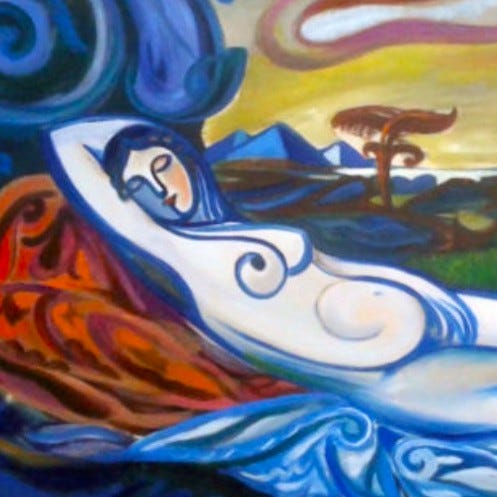
On the flip side, there are many who praise sleep for its special place in human life. Sleep is a state of altered consciousness where dreams occur and visions are revealed. Men of science and industry may view it as a limiting factor, but the world’s religious and artistic authorities have often regarded sleep as a time of great importance.
From the Bible, in Book of Psalms, Psalm 127 tells us: “It is vain for you to rise up early, to sit up late, to eat the bread of sorrows: for so he giveth his beloved sleep.” There are exhortations against too much sleep, but sleep itself is not described as an inherent waste of human time.
In the Tao we find similar sentiments. In the Tao Te Ching we read: “Nature does not hurry, yet everything is accomplished.” The Taoist writer Zhuangzi adds, “The true man of old slept without dreams and woke without worries.”
Buddhist traditions typically include rules about sleep and even recommend a preferred sleeping posture, yet sleep itself is never described as wasted time.
William Shakespeare, that great chronicler of the human condition, writes about sleep in Macbeth in these classic lines:
“Sleep that knits up the ravelled sleeve of care,
The death of each day’s life, sore labour’s bath,
Balm of hurt minds, great nature’s second course,
Chief nourisher in life’s feast.”
It is the final line—chief nourisher in life’s feast—that catches my eye and confirms the experience I am having as I grow older, wiser, and more secure in my place in life. I am not dead when I am asleep. I am far beyond merely resting.
Sleep, when cultivated and placed in its proper context, is an incredible gift that allows for an enhanced way of living and is absolutely free to use. There are some basic requirements for good sleep: it needs to be dark, cool, and mostly quiet, and one needs long, uninterrupted stretches of time to sleep deeply. Assuming these conditions are met, sleep can become what it was always meant to be—an altered realm where life plays itself out in new and interesting ways.
Bryan Johnson is an unusual man with considerable resources, and he has made it his business to explore ways to extend human life and intercept the systems that ultimately end in death. Of sleep, he claims that “If you get sleep wrong, everything else in health fails.” Sleep is where the body performs much of its repair work, cleaning and restoring systems throughout the body, including those in the brain. For those who prefer to lean on research, it is readily available. There are ample studies that support Johnson’s position that sleep may be the most important biological maintenance process humans have.
But what if a person were actually more “alive” in sleep than when awake? What is our natural state? Certainly, sleep is a repair state, implying downtime as opposed to uptime. But bodily regulation is not the penultimate purpose of sleep or rest. In rest, we think. We compare. We contemplate. We contextualize. We add meaning and value to the other events of our lives.
Imagine a chess match in which the players spend very little time actually moving the pieces and much more time thinking about the next move and the larger strategy. What, then, is the true chess match? What is the most important part of the game? Is it moving the queen, or thinking about where to move the queen?
There is also the further idea that one’s waking conscious state is not even the primary location of our larger selves. What if the conscious mind is not the true driver of human behavior? Instead, our waking personality may function more like a narrator, interpreter, or public-relations department for deeper processes occurring outside awareness.
This idea appears in different forms across many thinkers.
For example, neuroscientist Michael Gazzaniga studied patients whose brains had been surgically separated between the hemispheres. These experiments suggested that the conscious mind often behaves like an interpreter, creating a story about events after they occur. In other words, the conscious self explains behavior but does not necessarily cause it.
The true driver of behavior may arise from instinct or from processes operating below the level of conscious thought. The meaning and conscious awareness of an event may therefore be constructed afterward—sometimes only later, perhaps even during sleep, when the mind reflects on and integrates what has already happened.
Social psychologist Jonathan Haidt developed a similar metaphor. In The Righteous Mind he argues that reasoning usually justifies instincts rather than producing them. As he famously puts it, “The emotional dog wags its rational tail.”
A true pioneer in the idea that human motivation is driven by forces far below conscious awareness was Sigmund Freud. He proposed that the conscious mind is only a small part of the psyche.
In psychoanalysis:
Id → unconscious drives
Ego → conscious identity
Superego → internalized moral authority
Another influential perspective comes from cognitive scientist Daniel Dennett, who argues that the “self” is more like a narrative constructed by the brain. In his book Consciousness Explained he writes, “The self is a center of narrative gravity,” meaning our identity is essentially a story our brain tells about itself.
In this view, our waking life functions partly as a kind of public-relations system, constantly explaining and promoting our choices and actions. This might even help explain why figures like Edison and Musk constructed narratives about needing very little sleep. Perhaps the story sounded good—productive, heroic, efficient—even if the biology was telling a different story.
Further evidence that important processes occur outside conscious awareness comes from neuroscientist Benjamin Libet. Libet found that brain activity initiating a decision appears before a person becomes consciously aware of deciding. As Libet wrote, “The initiation of the voluntary act begins in the brain unconsciously.”
This suggests that the conscious mind may simply become aware of decisions already underway. These theories and observations challenge the assumption that the human being is merely the sum of biological processes and electrochemical impulses. If something occurs outside of conscious awareness, what proof do we have that it is happening entirely inside the body at all?
There is strong evidence that thoughts and motivations arise from processes within the brain, but we have also long dismissed religious or metaphysical explanations for human behavior. Much of modern thinking rests on an atheistic or materialist assumption: that our waking lives provide sufficient evidence for how the world works, and that we can identify the non-divine origins of natural phenomena. We know what makes the sun shine and the plants grow, and we know where babies come from.
But if our core self is not the part that appears front and center in the conscious mind, and if sleep serves as a doorway to that deeper self, then what we are—and perhaps even our purpose—may need to be reconsidered. I’ve noticed that as I’ve gotten older, my interior landscape has expanded. I have much more life to think about now, and I can pore over the details of my life, mining them for meaning. I have also read more and learned about subjects far removed from my own personal concerns. All of this becomes grist for my vastly expanded internal mill.
In sleep, this process is enhanced because there are no external distractions. A cold, dark room, limited food, no alcohol, and quiet take me to a place where the past, present, and future—where “me” and the many characters of my life, real and imagined—merge to form a matrix of life that feels larger than myself.
I think these places are real. They are as real as I am. What is “me” may not be all that important. I will die, and the world of my sleep may be the world I inhabit forever—or at least until the next instance of me lights upon some biological form.
This is where my thoughts have been running lately, and it feels true, at least for now. I’ll sleep on the idea further, and we’ll see what emerges in that developing world.