

The Super Bowl halftime performer this year featured a Puerto Rican artist who performed most of the show in Spanish. For Spanish speakers, this may have been a treat, but for most viewers it was a yawning moment. A football stadium notoriously has poor sound, and few people can understand what even a native English speaker—someone like Mick Jagger—is saying in that setting anyway.
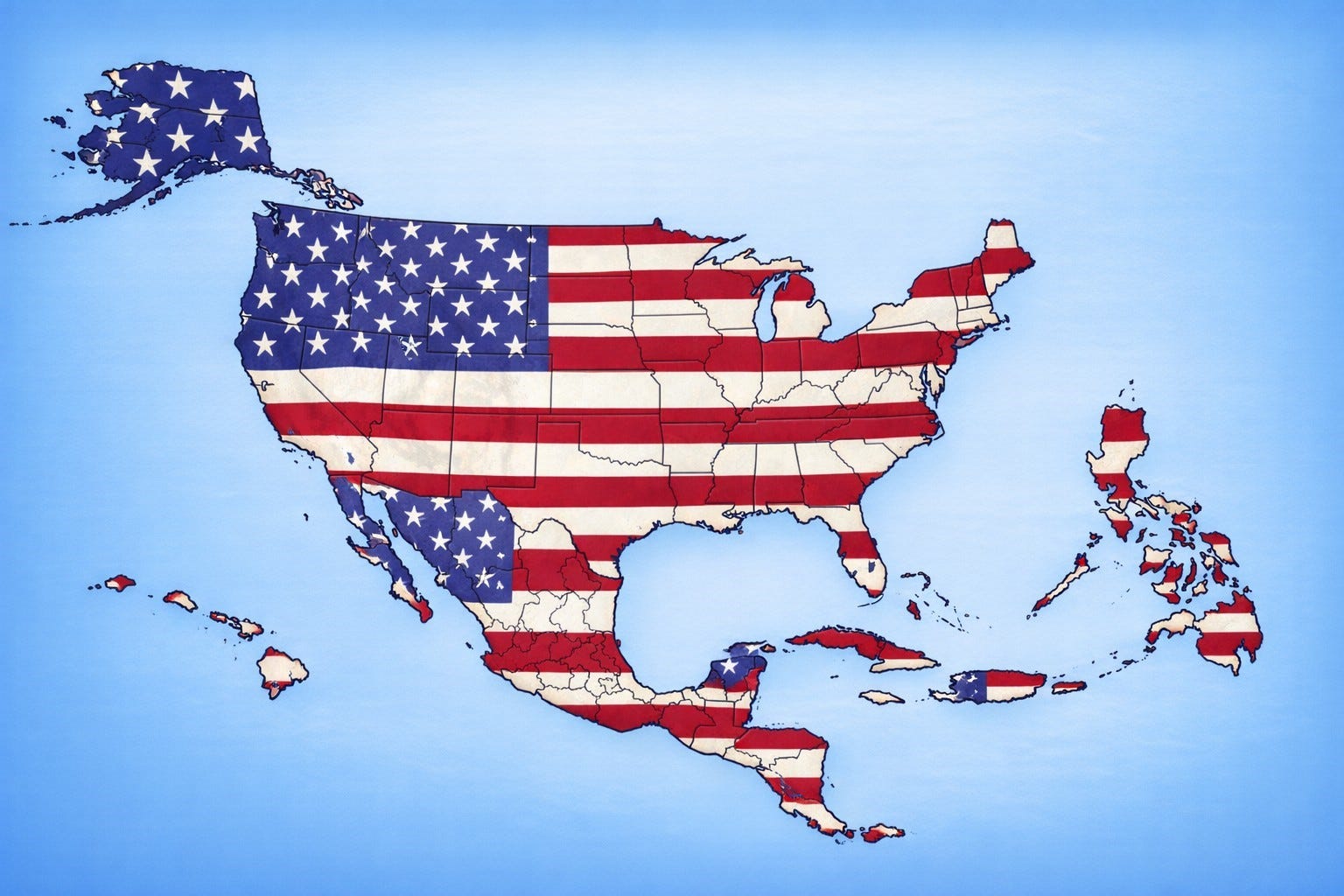
One may read into the performance whatever one likes, but it is clear that demographic trends in the United States are moving toward a larger Spanish-speaking population. Spanish is the native language of Puerto Rico, an island that was once part of the massive Spanish Empire. Had the empire-builders of nineteenth-century America had their way, the United States might already be a Spanish-speaking nation—or the leader of a vast multilingual empire composed of English, Spanish, French, and numerous native languages, all attempting to cooperate within a representative democracy.
We did not go that way, but we could have. The United States had many empire-building moments, and I maintain that we passed on all of them, for better or for worse. When the United States took in Puerto Rico as a territory, for example, it was a prototypical moment to expand into empire—and the opportunity passed.
In 1898, a surging United States was more than a century removed from the American Revolution. The Yanks no longer feared the British Lion and had largely accommodated themselves to the sprawling British Empire, which included the nearby commonwealth of Canada.
American attitudes toward the tattered remnants of the once-enormous Spanish Empire were quite different. Cuba had been Spanish for four hundred years but was now in open revolt. The United States was Cuba’s dominant trading partner, and American leaders sensed weakness. At that moment in history, when Americans sensed weakness, they pounced.
That February, the USS Maine mysteriously exploded and sank in Havana Harbor, killing 250 American sailors. The incident set in motion a ten-week war with Spain that the United States utterly dominated. At its negotiated conclusion, the United States found itself in possession of what remained of the exhausted Spanish Empire: Cuba, the Philippines, Guam, and Puerto Rico.
If there was ever a moment for the United States to declare itself an empire in the European mold, this was it. Both Cuba and the Philippines eventually became sovereign countries, while tiny Guam and Puerto Rico became—and remain—“U.S. territories,” a piece of weasel wording that says they are neither states nor sovereign.
But what if the United States had become an empire? Empires have conferred real benefits, as history repeatedly demonstrates. Would the United States have succeeded as an empire, and how might that decision have altered both the nation and the world?
One could argue that empires transmit habits and values, and that the United States might have done so from a stronger strategic position had it declared an empire early on. The Roman Empire spread the idea of citizenship—an identity that carried loyalties and benefits beyond the clan or tribal unit. In this sense, the Roman model marked a break from the long-dominant tribal order. The Romans centralized government and undertook massive public works, including aqueducts and sewer systems. It was only when the empire grew too large and too wealthy that it began to wither at the edges and rot from within. Nevertheless, it lasted over 800 years.
The British Empire conveyed its own habits and values, and one need only look at a list of the world’s most advanced economies to see the results. The United States, Canada, Australia, and New Zealand—along with a few others—are among the wealthiest and most developed nations on earth, and all are former British colonies. Rather than becoming the world’s largest democracy, India might well have devolved into a festering cycle of murder and reprisal, not unlike the modern Middle East, were it not for a centory of British rule.
An American Empire might have engaged the nation in world affairs in a way that prevented the twentieth century’s worst human catastrophes. Had the First World War never occurred—or had it been shortened by earlier American involvement—there would have been no second world war, no Nazis, no Soviet Union, and no Holocaust.
Empire would also have expanded markets. For the British, it created outlets for ambition and escape valves for social pressure. Landless ‘second sons’ often moved to colonial America, and brought with them determination and a will to gamble on business ventures, many of which succeeded. The United States is littered with Scottish place names because defeated and demoralized Scots, denied opportunity at home, distinguished themselves abroad in the Empire. Might those denied opportunity in the Jim Crow South have found a similar path in the far reaches of an American Empire? Might their presence have spread across the world under an American flag?
Empire, however, would have come at a cost. It would have meant a far larger military and a more overtly militaristic society. Empire requires the willingness to impose one’s will by force when necessary—and often when merely convenient. An American Empire would have required a large standing army, affecting everything from resource allocation to family size. Maintaining the empire would have dominated American politics for generations.
And yet, while the United States has long eschewed the language of empire, one could argue that it possesses one anyway—an empire inherited from the British without formal treaties. The United States has controlled territories beyond its borders at various times and for various reasons. In practice, we seem to have inherited the duties of empire without its benefits. To this day, we do the work of empire, as we did in Afghanistan, offering a localized version of our habits and values—an offer that is most often rejected. A formal empire might at least have conferred benefits that mere economic dominance and military supremacy have not. An Empire would have created a whole class of ‘colonial men’ who had been to the outposts, served, and come home hardened.
It is worth noting that Britain no longer has an empire, yet it continues to receive immigrants from its former colonial possessions. Pakistanis now make up a growing share of the British population, much as Latins constitute a growing portion of the American population. The absence of a formal empire, it turns out, does not prevent a country from exhibiting many of the features of one, including high rates of immigration.
This is why talk of empire matters. If a nation bears the responsibilities of empire, it should also possess the rights of empire—including the right to exploit natural resources. Otherwise, the home country itself becomes the resource, and it is being exploited, just not for the benefit of the host population. This dynamic is unavoidable absent impenetrable borders, which neither Britain nor the United States possesses.
And what about China? Does it harbor imperial ambitions? In some ways, China resembles an earlier version of the United States; in others, it does not. Should China begin to behave more openly as an empire, there may be peoples around the world who wish that, when the imperial moment presented itself, the United States had aimed a little higher. I strongly suspect this will not be the case.
China struggled for centuries simply to unify the territory it occupies today. The modern Chinese state dates only to 1949, and the regions surrounding China possess strong and distinct identities. Neither the Koreans, Vietnamese, nor Japanese are ripe for colonization.
Overall, it appears that the United States passed on formal empire during the waning days of the very idea of empire—and that moment has now passed. We may soon find ourselves in the waning days of the nation-state itself, as arrangements increasingly centralize around other poles, such as technology or defensible geography. The imperial moment is over; the nation-state, bound together by overlapping treaties, currently reigns; and the next great organizational idea has yet to reveal itself.
Did you like this? Let me know by leaving a tip here.