

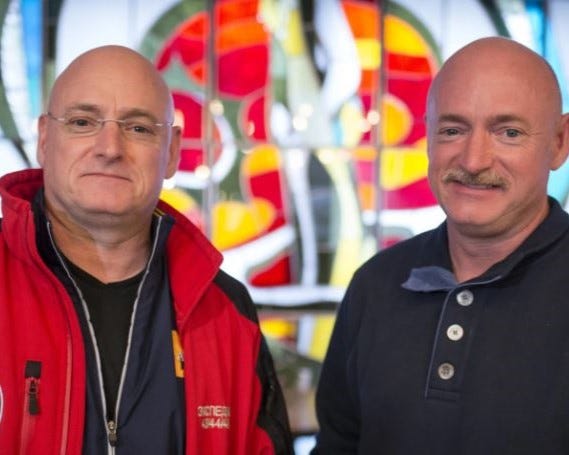
Mark Kelly has been in the news lately for suggesting that American military personnel are not required to follow unlawful orders. His intention and accuracy are in dispute, and it is unfortunate that his public reputation may come to be dominated by this kind of political controversy, because his place in biological history is already cemented.
Mark Kelly has an identical twin brother, Scott Kelly, and together they constitute a uniquely valuable biological case. Scott Kelly spent 340 days in space while Mark remained on Earth. When Scott returned, scientists compared changes in gene expression, cognition, vision, immune response, and epigenetics.
Our traditional understanding of human twins would not account for what Mark Kelly later revealed in a tweet about his living twin: “I used to have an identical twin brother.” While the twins still look alike, the way their core DNA expresses itself has changed.
That Scott’s epigenome would be altered by his unusual experience is not particularly surprising; that is precisely what the epigenome is meant to do. It may have been similarly altered had he gone scuba diving every day for a year. The more interesting question has to do with why the change occurred. As Cheryl Walker, Ph.D., director of the Center for Precision Environmental Health at Baylor College of Medicine, puts it: “We don’t know whether those changes in the epigenome are good and are helping the human body adapt to space, or whether they are reflecting an adverse effect of space.”
Did you catch that? We don’t know whether the changes rendered in Scott Kelly’s biological coding represent devolution or evolution. Or, to paraphrase Shakespeare: “Dysfunction or adaptation; that is the question.”
What if it’s evolution, and what we see in Scott Kelly is the leading edge of what humans will become when thrust into space permanently? What if we are that adaptable? And further, what if adaptation is the core protocol of life itself? What if everything is adaptive behavior? I mean everything: poetry, rape, war, invention, murder, sloth, Epstein, democracy, nuclear weapons, and sugary carbohydrates.
Throughout the natural world, there are remarkable examples of extreme adaptability. Survivors adapt—or they do not survive for long. Apples, for example, are heterozygous, meaning that if you plant the seed from a given apple, the tree that grows will not produce the same apple. The apple tree rolls the dice with each generation in the hope of producing enough hardy varieties to adapt to whatever environment it encounters. Humans hold the apple constant by grafting the limbs of pleasing varieties onto other trees so we can keep producing the ones we like, but the seeds are programmed to reshuffle characteristics with each generation. If some of those adaptations fail, so be it.
Humans, too, are marvels of adaptation, which is why we have pushed our presence into every corner of the globe. Eskimos can live in extreme cold on a diet of mostly animal blubber, while natives of the Amazon can live in perpetual heat on a diet of plants and roots. These humans share the same DNA, yet are adapted to radically different conditions. Each person begins with half the DNA of each parent, but variation remains; even non-identical twins from the same parents are different.
Like apples, humans roll the dice with each generation.
These adaptations are biological—hardwired—and they operate at two speeds. There is adaptation driven by natural selection: over time, some humans develop greater height, more body hair, or different skin pigmentation (the genome, or “hardware”). And there is the adaptation Scott Kelly experienced, in which his body adjusted to a current environment (changes to the epigenome, or “software”).
Epigenomics is a relatively young science, concerned with these more rapid changes in DNA expression. Each cell contains the full DNA sequence, but it is the epigenome that tells liver cells to behave like liver cells. Because cells must often adapt to rapidly changing conditions, the epigenome is positioned to react quickly—sometimes in ways we would prefer it not to. It allows for survival if a food source suddenly disappears, but it also allows smoking to affect your grandchildren, even if you die before they are born and their parents never smoked.
All of this seems like a form of natural genius—until the implications sink in. If epigenetics is as logical as natural selection, then it does not make mistakes. That would imply there is no dysfunction, very little cultural adaptation separate from biology, and that all human adaptation originates in the body. If nature does not make mistakes, then there are no pathologies—only conditions we choose to define as problems. There is merely the relentless adaptation of humans to circumstance and the biological imperative to keep rolling the dice until someone survives. Such a view would both confirm and radically depart from prevailing theories of human behavior. It would move us beyond the familiar nature-versus-nurture debate.
Consider a few examples.
Perhaps the human lifespan itself is adaptive. It has been observed that mammals typically live about six times the age of maturity, which for humans suggests roughly 120 years. But perhaps this is not a ceiling on potential life, but an adaptive limit. Maybe our genes determine that after 120 years life is no longer advantageous—or they receive a signal that space must be made for the next generation. One hundred and twenty years may be enough time to observe the full outcome of a particular set of DNA instructions, after which it is time to move on to the next experiment.
Much ink has been spilled over the nature of sexual attraction and gender identity. But what if this, too, is adaptive? What if same-sex attraction is not merely inborn, but malleable—and socially necessary? Yes, we are born with a sex chromosome, and there are only two options, but expression varies. Sexual behavior changes over time, and perhaps this reflects more than shifting cultural norms. Consider how sodomy gave way to homosexuality, which gave way to the all-purpose and all-encompassing “gay.” What if these shifts were adaptations—first to societies where powerful men monopolized women and used sex to exert dominance over less powerful men, and later to societies so safe that men with more traditionally feminine traits could thrive?
The birth cycle is a hotbed of adaptive behavior. We have clearly manufactured a problem we call “teen pregnancy.” Biology, however, suggests that young females are meant to be pregnant; their bodies are at peak fertility, and boys of the same age are driven powerfully to pursue them. Yet testosterone levels in young men are reportedly falling as reproduction is pushed to the far edges of female biological possibility. Perhaps this is adaptation in action, aided by increased body fat associated with higher consumption of refined sugar. What if abortion is adaptive—if the body determines that an early pregnancy would prevent a later, more viable one? What if infertility is nature’s way of saying, “I’m out of time,” or “I won’t live long enough to see this child through”? Even the decision never to have children may be biologically rooted.
What if depression is not a chemical imbalance, but a rational response to an arid and lonely environment? The same might apply to suicide—what if, under certain conditions, it makes biological sense? Death may occur when the body determines that the dice roll failed and the organism should be discontinued. Miscarriage is often described as the body terminating a flawed process; perhaps suicide is an analogous mechanism.
What if autism is adaptive? Some people may need the ability to focus relentlessly on a single task to the exclusion of all else. These individuals were once considered eccentric; once we applied a disease model, they became “maladaptive.” Perhaps they never were.
It is commonly accepted that gang activity is adaptive to the decline of male involvement in childrearing. Gangs become substitute families, and older members serve as surrogate mentors. The formation and fragmentation of social tribes is universal; criminal gangs may simply represent another adaptive structure, servicing markets ignored by dominant institutions.
One could extend this logic further, to behaviors we classify as pathologies or crimes—homelessness, abuse, rape, infanticide. Might these, too, have natural, epigenetic origins?
The long process of selecting and rewarding certain behaviors while isolating and punishing others is itself adaptive, producing winners and losers with no final endpoint. As we better understand the role epigenetics plays in human life, our definitions of universal goods will change along with it. We will adapt—whether we like it or not. Humans have always believed they understood the universal good of their era. Perhaps we should be less certain, given that we do not know what adaptation lies just ahead.
If adaptation is the core of the human process, is there such a thing as evil? Is there a violation of the Dharma, the Tao, or basic Judeo-Christian values? I would say yes—there is maladaptation, and this lies at the core of human spirituality.
Humanity is not passive in the adaptive process; we are willful. We can examine our thoughts and choose our actions—as Scott Kelly did when he chose to remain in space for a year—and as a result, we are now responsible for a significant portion of the adaptation of life on Earth. Just because something is natural does not make it good.
Humans are spiritual machines, not merely organisms adapting to physical reality. There may be a spiritual adaptation mechanism at work—one we may eventually discover and come to accept. Consciousness itself may have a deep adaptive dimension.
The Taoists say there is a constant, called the Tao, and that our well-being is tied to our ability to align with it. An eternal God, the Dharma—it is all rooted in the idea of a constant around which humans revolve. We now know that humans are infinitely adaptable, and we may yet find that our core function in life is to adapt toward an eternal, and eternally good, constant.
Like what you read: YOu can leave me a tip here.