

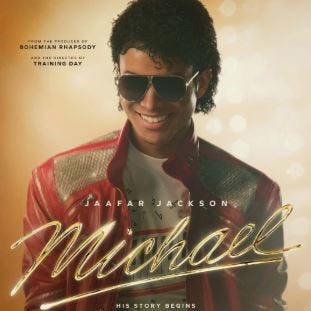
Hagiography is defined as a biography that treats its subject with reverence, idealizing their life and deeds without skepticism, and—of course—editing out any actions that cast a negative light. This is the approach of the new film Michael, as applied to Michael Jackson. This is the Michael Jackson we wanted, not the one we got. This is a Disney version of Michael, free of sexuality or personal flaws.
The story begins in 1966 in Gary, Indiana, where a steelworker, Joseph Jackson, drives his five boys to practice making soul music in their tiny living room. The four older boys are fronted by a very young Michael, who already has an angelic voice and the soulful instinct to match it in his movements. Early on, it is shown that Joseph is a tyrant who beats Michael for even the slightest resistance to his patriarchal rule. The film ends in 1988 with Jackson, now at the peak of his stardom, performing “Bad” to a packed stadium in London.
For anyone who was young when Jackson’s Thriller album was released, the movie offers a pleasant trip down memory lane and a glimpse of what it sounded like in the studio as he laid down his vocals. He was gifted as a vocalist and instinctive as a dancer—a special talent. Jaafar Jackson, Michael Jackson’s nephew, does a tremendous job recreating his style and movements, and the concert sequences are beautifully rendered.
As I was watching the movie, however, I noticed that Janet Jackson was missing—even in the early scenes when the rest of the family was present. La Toya Jackson appears, but not Janet, which is odd. Of the many talented Jackson children, Michael was clearly the standout star, but just behind him was Janet Jackson. Her albums from the 1980s were huge sellers, and her singles were ubiquitous on the radio. And yet, she is missing entirely from the movie.
Here is one of Janet’s videos from the same period where Michael was making Thriller and Beat It.
Michael is presented as he appeared in the press at the time: calm, with a high, disarming voice, very kid-friendly. His dance sequences, while impressive in most ways, are conspicuously absent one salient feature—his tendency to aggressively grab his crotch. This Michael is like a Ken doll, with a smooth plastic surface where his sexuality might be. He appears with many children in the film, but always as a polished superstar, setting aside portions of his valuable time to sit with ailing youngsters.
Two elements that were detrimental to Jackson’s later development are addressed, but in an innocent, almost explanatory way. The first is his inclination to alter his appearance through surgery. Michael claims this was done to make his face more symmetrical. The second is the well-known incident during the filming of a Pepsi commercial, when his hair caught fire. He is given pain medication afterward, which the film subtly implies may have introduced him to drugs.
But, hey—so what? His music was really good, and he was an entertainer who was genuinely entertaining. I had no moral objection to giving my money to his hagiographical film, and I’m glad I did. Movies matter to me, and this was a good one.
Besides, the record on the real Michael Jackson is no secret. Anyone who wants to know—or already knows—about his highly troubled life isn’t going to be swayed by a more realistic biopic that covered his arrests and trials for molesting young boys. We already know this.
But Jackson really is a special case. His flaws were enormous and extremely well recorded and here is a list, through the years, of what Michael was up to after the filmed version stops.
1988 – Opens Neverland Ranch, an isolated compound with a zoo and carnival rides. He invited children to stay there without their parents. This was a groomer’s paradise.
1989 – Named “Artist of the Decade” and crowned the King of Pop in the media. The title was notable as a counterpart to the “King of Rock and Roll,” long associated with Elvis Presley.
1991 – Releases Dangerous, which was not nearly as popular as Thriller or Bad. Musically, he had peaked.
1992 – Launches the Dangerous World Tour with an altered appearance and weird, fascistic militaristic stage costuming.
1993 – First child sexual abuse allegations surface. Michael Jackson is accused of molesting a boy, Jordan Chandler, at Neverland. Jackson acknowledges the boy stayed at his home and in his bed but denies any abuse.
1994 – A pivotal year. Jackson settles with the Chandler family for a reported sum (often cited around $20 million). Shortly after, he marries Lisa Marie Presley, a move widely viewed as an attempt to appear as a normal heterosexual man.
This aired, which looks entirely staged. They were married for 20 months.
1995 – Releases HIStory, which does not match his earlier sales and directly confronts media criticism and accusations. By this point, most of his music centered on his own public narrative.
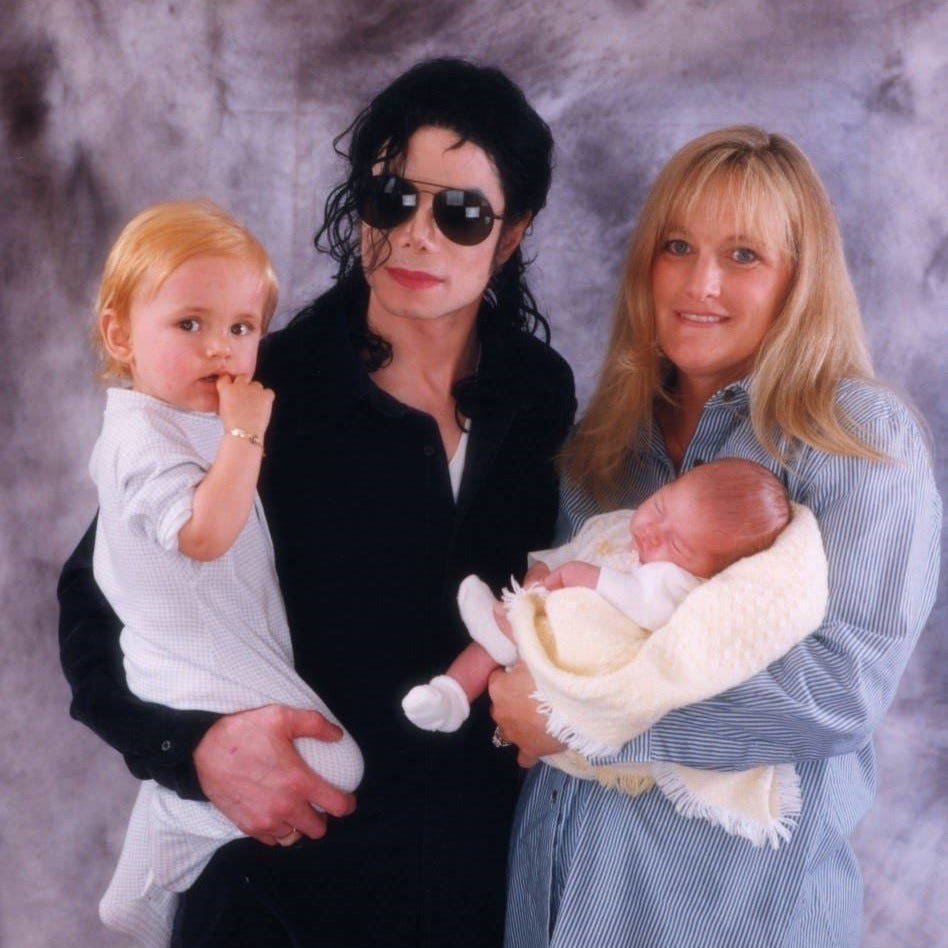
1996 – Marries Debbie Rowe, a nurse who later gives birth to two children which he claims are his own.
1997 – Birth of his first child, Michael Joseph Jackson Jr. (“Prince”).
1998 – Birth of Paris Jackson.
2002 – Briefly dangles his third child, Prince Michael Jackson II, over a hotel balcony in Berlin, prompting widespread criticism.
2003 – The documentary Living with Michael Jackson airs and proves highly damaging to his public image. He opens up to journalist Martin Bashir, discusses children sleeping in his bed, denies extensive plastic surgery, and frames Neverland as an attempt to reclaim a lost childhood. The portrayal reinforces the perception that he is increasingly disconnected weirdo and in no way is related to the old Michael Jackson.
2004 – Charged again with child molestation; his public appearances further underscore how far he has drifted from his earlier image. His mugshot is shown around the world.
2005 – After a lengthy trial, he is acquitted, and he moves out of the United States.
2009 – Announces This Is It, a planned comeback concert series, but dies before it begins. The official cause of death is acute propofol intoxication, combined with other sedatives. Propofol is a powerful anesthetic typically used in surgical settings, which he had been receiving from a physician to help him sleep.
Of course, all of this eroded what Jackson had contributed to the cultural cohesion of the American tapestry. He, along with several other black entertainers, had helped lay to rest the old claim—often associated with Elvis Presley—that white America would only accept black music if it were delivered by white performers.
I generally abhor the terms “white music” and “black music,” and a strong case can be made that such categories are meaningless. Still, it’s true that certain musical forms found larger audiences within the two ethnicities. There were more white country stars and more black soul stars. The Jackson 5, along with a few others, helped break down those boundaries, and Michael Jackson in particular was accepted and revered across them.
Here isThe Jackson 5 on the Ed Sullivan show:
But his controversies destroyed that achievement and complicated his legacy as a unifying cultural figure. He was unraveling at roughly the same time that O. J. Simpson was destroying his own public standing, and the comparison has become part of how people understood the era. OJ was a malevolent killer, and Jackson was a child molester and there was no denying it, then or now.
Also, there is the lingering question of why Jackson went so far out of way to make his features and skin whiter. Why did Michael Jackon want and get a perfect white family? Those kids are clearly not his kids.
This is Michael Jackson, Junior

This is Paris Jackson

This is Blanket, now known as Bigi:

Michael and Rowe with kids
In the film, Michael Jackson is portrayed as trying to break free from his father in order to fulfill his “destiny,” which is to unite people through music and dance. This reflects a broader belief—held by Jackson, his family, and many popular entertainers—that they are important figures beyond the realm of entertainment, serving some larger public function.
If that were true, it would be quite convenient for Jackson, who profited enormously from the sales of his music, shows, and likeness. He would, in effect, be in creative control of “unity,” and that would be highly profitable.
Except, this is nonsense. I love music and listen to it every day. I love movies and literature, and I acknowledge the importance of culture, including pop culture. I’ve educated my kids in American culture. But what truly binds people together is clean water and indoor plumbing. Material needs come first; culture follows, and politics follows after that.
In the film, there are sweeping shots of crowds—fans weeping and reaching out to Jackson as if he were a kind of savior. But the Jackson family and estate seems to have misinterpreted what those adoring fans mean. For the actual concert attendees, those moments are fleeting. After the show, people go home and return to their lives. Jackson likely meant more to himself than he did to most of those fans. Most were like me: they enjoyed the music, recognized the talent, but did not see him as a transcendent figure.
Perhaps Janet Jackson saw it that way as well—which may help explain why she kept her distance from the film.
So, see Michael, but remember you are watching mythmaking on the part of a wealthy family that is willing to throw over its own members to keep the dream alive. It’s also worth noting that their father, Joseph Jackson, is cast as the primary villain. Colman Domingo delivers a masterful performance inhabiting him, and he is presented as the root of all of Michael’s troubles. But the Jackson 5 were the creation of Joe Jackson and there would be no Michael but for Joe, who really did work in a steel mill and train his kids when he got home.
And further, Joseph delivers what may be the film’s most revealing line: “You want to be surrounded by people who say yes to you all the time?” he asks his super star son. (In the film, Michael never calls him “Dad,” only “Joseph.”) In hindsight, that question points to what may have been Jackson’s fatal mistake. No one told him no—even when he had a doctor put him in a coma so he could sleep.
That, more than anything, explains why the actual Michael Jackson is dead and only the myth lives on.
My son saw this and enjoyed it. I'm in two minds - You Are Not Alone is one of my favourite songs, and yet I've believed him to be guilty ever since I saw the enraged faces of the police spokesmen after Jackson settled out of court back in 94.